

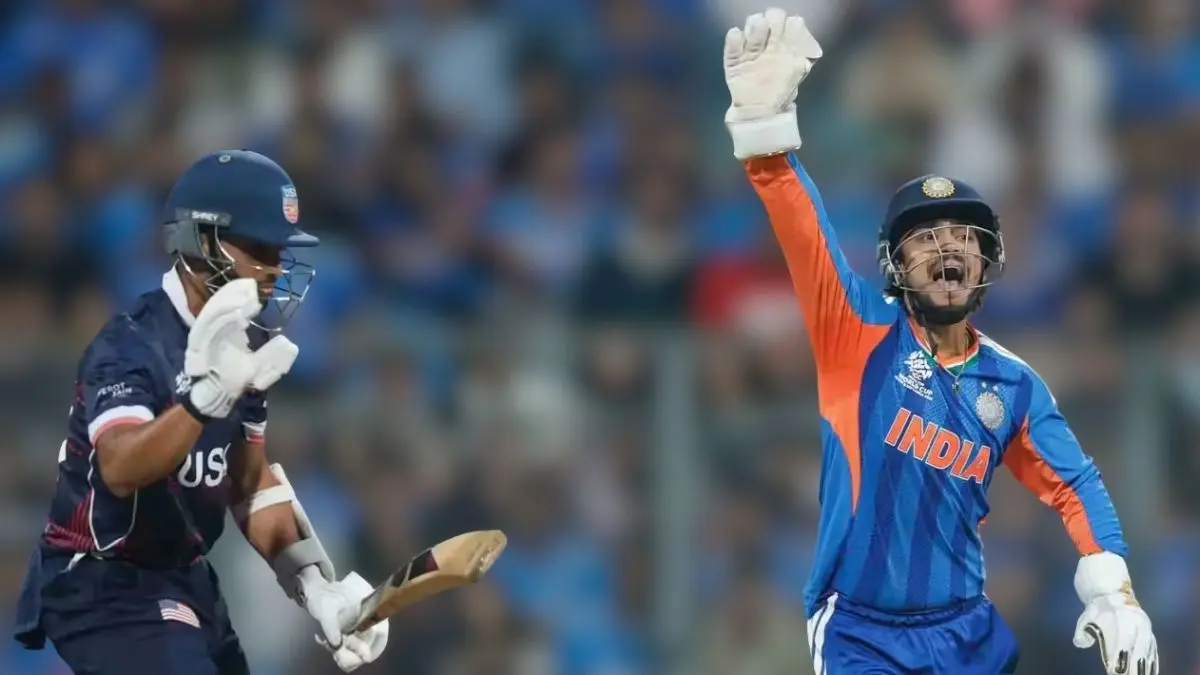
India beat USA by 29 runs in the T20 World Cup 2026 as Suryakumar Yadav smashed 84 off 49. Read full match highlights, batting, bowling, and key moments.
India Batting
| Player | Runs | Balls |
| Suryakumar Yadav (c) | 84* | 49 |
| Tilak Varma | 25 | 16 |
| Ishan Kishan (wk) | 20 | 16 |
| Axar Patel | 14 | 11 |
| Rinku Singh | 6 | 14 |
| Hardik Pandya | 5 | 6 |
| Arshdeep Singh | 4 | 6 |
| Abhishek Sharma | 0 | 1 |
| Shivam Dube | 0 | 1 |
| Varun Chakaravarthy | 0 | 0 |
USA Batting
| Player | Runs | Balls |
| Shubham Ranjane | 37 | 22 |
| Sanjay Krishnamurthi | 37 | 31 |
| Milind Kumar | 34 | 34 |
| Mohammad Mohsin | 8 | 9 |
| Andries Gous (wk) | 6 | 9 |
| Saiteja Mukkamalla | 2 | 7 |
| Shadley van Schalkwyk | 2* | 5 |
| Monank Patel (c) | 0 | 2 |
| Harmeet Singh | 0 | 1 |
The T20 World Cup 2026 clash between India and the United States at the iconic Wankhede Stadium in Mumbai delivered a thrilling contest packed with explosive batting, disciplined bowling, and moments of high drama. In front of a roaring crowd, India posted a challenging 161/9 and successfully defended the total, restricting USA to 132/8 to seal a convincing 29-run victory in Group Stage action.
The night belonged to Suryakumar Yadav, whose dazzling 84 off 49 balls earned him the Player of the Match award. His fearless strokeplay rescued India from early trouble and turned the momentum decisively in their favor.
Match Overview
India entered the contest as favorites, but USA showed grit and determination throughout. After winning the toss, USA opted to bowl first, hoping to exploit early movement under lights. Their plan worked initially, but they failed to contain India’s middle-order brilliance.
Result: India won by 29 runs
Venue: Wankhede Stadium, Mumbai
Toss: USA won and chose to bowl
India’s Innings: 161/9 in 20 Overs
India’s batting innings began cautiously, as USA bowlers applied early pressure with tight lines and aggressive fielding. The American attack struck quickly, dismissing an opener inside the powerplay and forcing India onto the back foot.
Early Setback
India struggled to find rhythm in the first few overs. The pitch offered slight grip, and USA seamers used variations cleverly. With wickets falling at regular intervals, the scoreboard pressure began mounting.
However, one man stood firm.
Suryakumar Yadav’s Brilliance
Suryakumar Yadav walked in during a tense phase and immediately changed the tempo. Known for his 360-degree batting, he unleashed a range of innovative shots — scoops, reverse sweeps, inside-out lofts, and trademark flicks over fine leg.
His innings was not just about aggression; it was about control. He assessed the field, targeted weak zones, and manipulated angles brilliantly.
Suryakumar Yadav – 84 (49 balls)
-
Boundaries: 8 fours, 5 sixes
-
Strike Rate: 171+
-
Match-defining knock
He built crucial partnerships that stabilized India’s innings and shifted momentum. Every time USA sensed an opening, Suryakumar countered with fearless hitting.
Key Contributions
While Suryakumar was the star, India received support from the middle order:
-
Tilak Varma – 25 (16): Played a brisk cameo that injected momentum.
-
Ishan Kishan – 20 (16): Rotated strike effectively and kept the scoreboard moving.
India accelerated in the final overs, but USA bowlers struck back with late wickets, preventing a total beyond 170.
USA Bowling Performance
The USA bowling unit showed discipline and fight. They never allowed India to run away completely.
Shadley van Schalkwyk – Leading the Attack
Van Schalkwyk was the standout bowler, using variations and clever pace changes to disrupt India’s rhythm.
Figures: 4/25
He removed key batters and kept India from launching a full assault at the death.
Other Contributions
-
Harmeet Singh – 2/26: Tight spells and smart field placements.
-
Ali Khan – 1/13: Economical and controlled.
USA’s bowlers executed their plans impressively, ensuring India had to work hard for every run.
USA Chase: 132/8 in 20 Overs
Chasing 162 was never going to be easy against India’s experienced bowling attack. USA started positively, with openers looking confident against the new ball.
Strong Middle Overs Resistance
USA’s middle order showed resilience:
-
Shubham Ranjane – 37 (22): Aggressive intent and clean hitting.
-
Sanjay Krishnamurthi – 37 (31): Anchored the innings with maturity.
-
Milind Kumar – 34 (34): Tried to rebuild after wickets fell.
The trio kept USA in the hunt, but India’s bowlers applied pressure relentlessly.
India’s Bowling Dominance
India’s bowling unit executed plans perfectly, mixing pace and spin to suffocate the chase.
Mohammed Siraj – Pace and Precision
Siraj bowled with intensity and accuracy, targeting the stumps and extracting bounce.
Figures: 3/29
His breakthroughs dismantled USA’s momentum at critical moments.
Arshdeep Singh – Death Overs Specialist
Arshdeep’s yorkers and slower balls proved decisive.
Figures: 2/18
He controlled the final overs expertly.
Axar Patel – Spin Control
Axar’s economical spell prevented USA from accelerating.
Figures: 2/24
He choked the scoring rate during middle overs.
India’s bowling unit functioned as a cohesive force, never allowing USA to dominate.
Turning Point of the Match
The decisive moment came when Siraj dismissed two set batters in quick succession. USA’s chase collapsed from a promising position to a survival battle. From there, India tightened the screws and never let go.
Suryakumar’s innings laid the foundation, but India’s bowling sealed the victory.
Tactical Analysis
India’s success stemmed from:
-
Smart batting recovery after early setbacks
-
Middle-order acceleration
-
Strategic bowling changes
-
Sharp fielding and pressure-building
USA showed improvement and competitiveness, especially with the ball, but lacked finishing power in the chase.
Crowd Atmosphere
The Wankhede crowd added electricity to the contest. Every boundary from Suryakumar triggered thunderous applause, and every wicket ignited celebrations. The stadium atmosphere reflected a World Cup knockout intensity, even in the group stage.
Player of the Match: Suryakumar Yadav
His innings combined flair, intelligence, and courage. Under pressure, he produced a masterclass that defined the match.
He proved once again why he is one of the most dangerous T20 batters in world cricket.
What This Win Means for India
This victory strengthens India’s position in Group Stage standings. More importantly, it highlights their ability to recover from difficult situations — a crucial trait in tournament cricket.
India demonstrated depth in batting and bowling, signaling strong championship credentials.
USA’s Takeaways
Despite defeat, USA showed:
-
Strong bowling discipline
-
Competitive batting partnerships
-
Growing confidence at the international level
Their performance proves they are no longer underdogs but serious competitors.
Final Thoughts
The India vs USA T20 World Cup 2026 match was a showcase of modern T20 cricket — explosive batting, tactical bowling, and relentless intensity. Suryakumar Yadav’s brilliance turned a fragile start into a winning total, and India’s bowlers finished the job with authority.
USA fought bravely but fell short against a more experienced side.
Matches like this highlight why T20 World Cup contests captivate global audiences — unpredictability, drama, and unforgettable individual performances.
India vs USA T20 World Cup 2026 Match Highlights
India’s total of 161/9 may look modest on paper, but the structure of the innings reveals a story of recovery, adaptability, and intelligent batting under pressure.
The first six overs belonged to the USA bowlers. India struggled to cross even a run-a-ball at one stage, with the new ball swinging slightly and gripping off the surface. USA’s seamers maintained tight channels, forcing false shots and creating scoreboard pressure.
The turning point came with the partnership between Suryakumar Yadav and Tilak Varma.
Suryakumar–Tilak Partnership
Tilak Varma played the perfect supporting role. While Suryakumar attacked, Tilak rotated strike and punished loose deliveries. The pair added a crucial stand that revived India’s innings and forced USA to rethink their bowling plans.
Tilak’s cameo may look small in numbers, but its timing was priceless. He absorbed pressure and allowed Suryakumar to play freely.
Once Tilak departed, Suryakumar shifted gears again.
Suryakumar’s Second Phase Acceleration
Great T20 innings are often divided into phases — survival, consolidation, and destruction. Suryakumar executed all three flawlessly.
In his second phase, he targeted spin. Using the crease brilliantly, he converted good deliveries into scoring opportunities. Reverse ramps over third man and lofted inside-out shots over extra cover stunned the fielding side.
USA’s bowlers attempted to push him wide, but Suryakumar adapted instantly. His bat speed and balance allowed him to generate power from awkward angles.
Every over he dominated reduced USA’s margin for error.
Death Overs Drama
The final four overs were a battle of nerves.
USA struck back with wickets at regular intervals, denying India a late explosion. Shadley van Schalkwyk returned to clean up the tail and finished with match-defining figures.
However, Suryakumar ensured India crossed the psychological 160 mark — a total that proved decisive later.
In T20 cricket, momentum often matters more than raw numbers. India finished with belief.
USA’s Chase: Intent vs Pressure
USA’s chase began with clarity: attack early, reduce scoreboard pressure, and force India onto defensive fields.
The openers showed positive intent, finding boundaries in the powerplay. For a brief period, the chase looked balanced.
But India’s bowling plans were meticulous.
India’s Field Strategy
India deployed aggressive infield positions early, cutting off singles and forcing USA batters to take aerial risks. The pressure of dot balls led to mistimed shots and eventual wickets.
Captaincy played a crucial role. Field placements were constantly adjusted to counter each batter’s strength.
This chess match between bat and ball defined the middle overs.
The Middle Overs Squeeze
Axar Patel’s spell was a tactical masterpiece. He bowled into the pitch, varied pace, and forced USA batters to hit against the turn. His control ensured the required run rate climbed steadily.
At the other end, Siraj attacked the stumps relentlessly. His length deliveries skidded through, making strokeplay risky.
USA’s batters fought hard, but boundaries dried up.
When chasing in T20 cricket, stagnation can be fatal. That stagnation arrived between overs 9 and 14.
USA’s Fightback Attempt
Shubham Ranjane and Sanjay Krishnamurthi attempted a rescue act. Their partnership briefly reignited hopes with calculated aggression.
Ranjane targeted the shorter boundary with clean hitting. Krishnamurthi focused on placement, threading gaps and rotating strike.
For a few overs, India looked under pressure again.
Then came Siraj’s breakthrough.
The Decisive Over
Siraj’s double strike shattered the chase. Removing two set batters in a single over turned the contest decisively. The USA dressing room fell silent, while the Indian crowd erupted.
From that moment onward, USA were chasing the game rather than the target.
Arshdeep Singh closed the innings clinically, executing yorkers with precision. The final overs showcased India’s superior experience under pressure.
Bowling Comparison
India’s bowling excelled in three areas:
-
Length control
-
Variation of pace
-
Field awareness
USA’s bowlers were impressive too, especially early on, but India adapted better as conditions evolved.
Experience separated the two sides.
Mental Strength Under Pressure
One of the defining aspects of this match was India’s composure. Even when early wickets fell, panic never crept in. Senior players guided the innings calmly.
Similarly, during USA’s promising middle phase, India stuck to plans instead of chasing magic deliveries.
Championship teams trust their systems — India displayed that trust.
Fitness and Fielding Impact
India’s fielding was sharp and energetic. Boundary saves, quick releases, and athletic stops saved at least 12–15 runs — a huge margin in T20 cricket.
Fitness is often invisible in scorecards but decisive in outcomes.
USA matched India in effort, showing growing professionalism in their international setup.
Tactical Lessons from the Match
This game offered valuable T20 lessons:
-
One anchor innings can define a total
-
Partnerships matter more than individual bursts
-
Bowling discipline beats raw pace
-
Fielding wins tight games
-
Scoreboard pressure is real
India executed these principles better on the night.
Tournament Implications
This victory strengthens India’s campaign momentum. Net run rate improves, confidence grows, and dressing room belief rises.
For USA, the match is a learning experience. Competing strongly against a powerhouse like India signals progress. With refinement in death batting, they can challenge top teams.
The T20 World Cup thrives on emerging nations pushing established giants — USA showed they belong on this stage.
Crowd Reaction and Global Audience
The Wankhede Stadium buzzed throughout the contest. Suryakumar’s innings drew standing ovations, with chants echoing long after his dismissal.
Globally, the match attracted massive viewership. Fans praised USA’s fight and India’s professionalism.
T20 cricket continues to expand its reach, and games like this accelerate the sport’s globalization.
Legacy of the Match
Years later, this match will be remembered for:
-
Suryakumar Yadav’s fearless artistry
-
India’s bowling discipline
-
USA’s spirited resistance
-
Tactical brilliance on both sides
It wasn’t just a win — it was a showcase of modern T20 evolution.
Closing Reflection
Cricket is a game of moments. One innings, one spell, one over can change everything. In Mumbai, Suryakumar Yadav created the defining moment.
India walked away with victory, but USA walked away with respect.
And for fans, it was another unforgettable T20 World Cup night.
India vs USA T20 World Cup 2026 Match Highlights

