
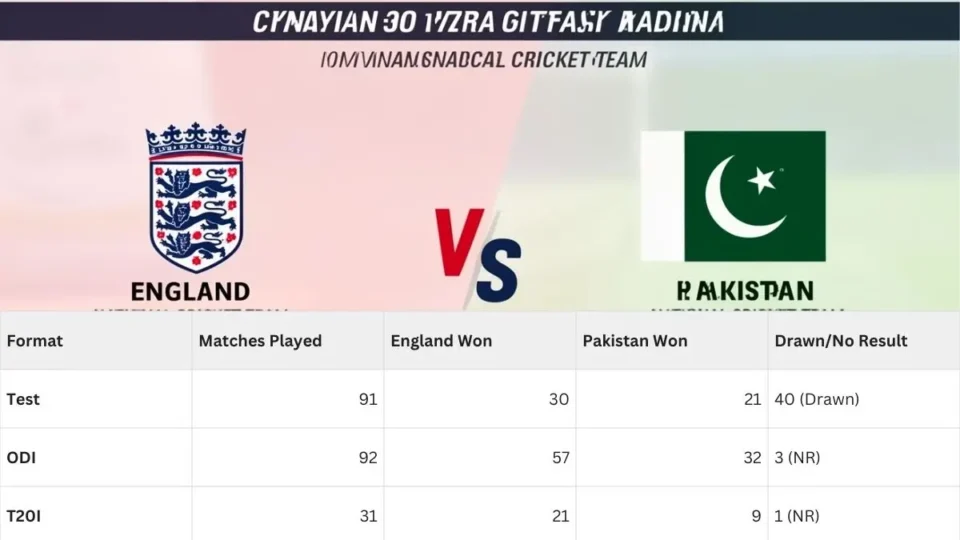
England National Cricket Team vs Pakistan National Cricket Team Stats
| Format | Match | England | Pakistan | Drawn |
| Test | 91 | 30 | 21 | 40 (Drawn) |
| ODI | 92 | 57 | 32 | 3 (NR) |
| T20I | 31 | 21 | 9 | 1 (NR) |
Present Player
| England | Pakistan |
| Liam Dawson | Fakhar Zaman |
| Adil Rashid | Mohammad Nawaz |
| Jos Buttler (Wk) | Babar Azam |
| Jamie Overton | Sahibzada Farhan |
| Ben Duckett | Salman Ali Agha (C) |
| Jofra Archer | Faheem Ashraf |
| Luke Wood | Shadab Khan |
| Sam Curran | Shaheen Afridi |
| Phil Salt (Wk) | Abrar Ahmed |
| Josh Tongue | Usman Khan (Wk) |
| Harry Brook (C) | Naseem Shah |
| Tom Banton | Saim Ayub |
| Will Jacks | Salman Mirza |
| Jacob Bethell | Khawaja Nafay (Wk) |
| Rehan Ahmed | Usman Tariq |
Cricket rivalries are like long-running novels — filled with twists, heroes, heartbreaks, and moments that linger in memory for decades. Among the most fascinating chapters in international cricket is the contest between the England National Cricket Team and the Pakistan National Cricket Team. It’s not just about bat and ball; it’s about history, pride, contrasting styles, and unpredictable drama that keeps fans glued to their screens.
When England and Pakistan meet, you never quite know what to expect. England, the birthplace of cricket, traditionally known for structure and discipline, often clashes with Pakistan’s raw flair and natural brilliance. It’s a classic contrast — method versus magic. And when those two collide? Fireworks.
Statistically speaking, the rivalry has been intense across all three formats — Tests, One Day Internationals (ODIs), and T20 Internationals (T20Is). According to head-to-head records:
-
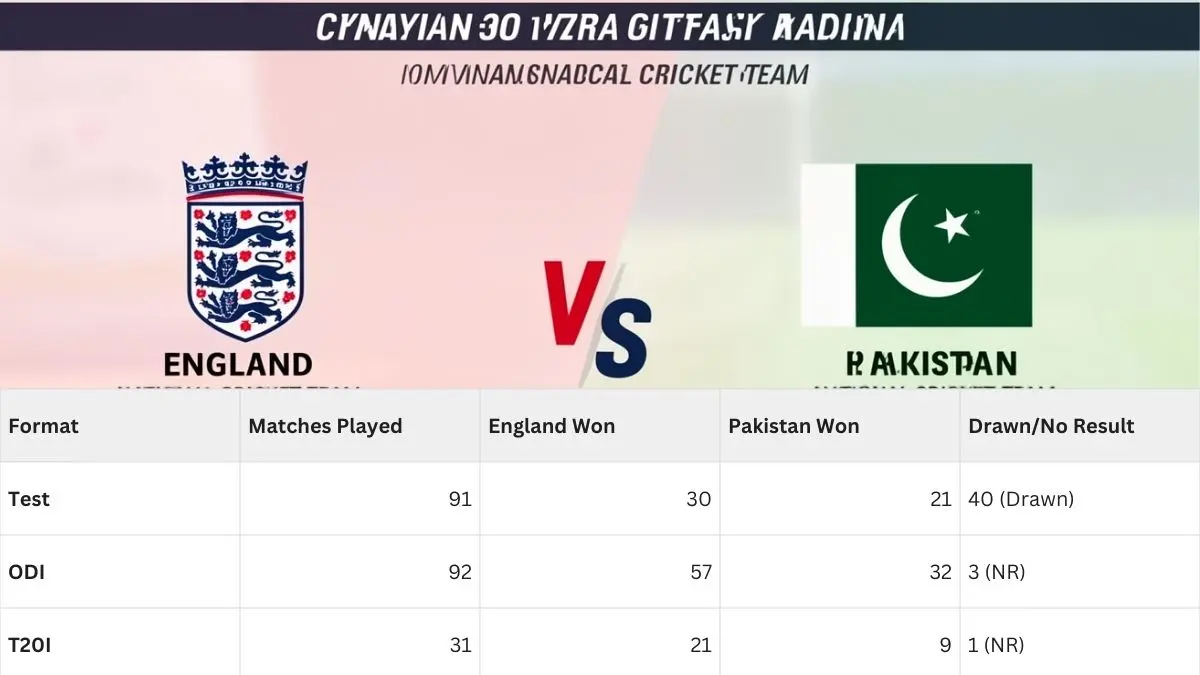
Tests: 91 matches – England won 30, Pakistan won 21, 40 drawn
-
ODIs: 92 matches – England won 57, Pakistan won 32, 3 no results
-
T20Is: 31 matches – England won 21, Pakistan won 9, 1 no result
But numbers only tell part of the story. Behind every statistic lies a tale of legendary innings, devastating spells, and heart-stopping finishes.
So let’s dive deep — format by format, era by era — and explore one of cricket’s most compelling rivalries in full statistical and emotional detail.
Historical Overview of England vs Pakistan Rivalry
The England vs Pakistan rivalry officially began in 1954 when Pakistan toured England for their first Test series on English soil. At that time, Pakistan was still a relatively young cricketing nation, having gained Test status in 1952. Few expected them to challenge England strongly. Yet, they shocked the cricketing world by winning at The Oval — a statement victory that announced their arrival on the global stage.
From that moment, this rivalry gained depth.
Throughout the 1960s and 1970s, contests between the two sides were largely Test-focused. Matches were drawn frequently — especially in England’s often unpredictable weather conditions — but they were fiercely competitive. Pakistan’s rise in fast bowling during the late 1970s and 1980s added a new dimension. England’s batsmen suddenly found themselves facing fearsome pace attacks that redefined the battle.
The 1980s and 1990s intensified the rivalry further. Pakistan produced legends like Imran Khan, Wasim Akram, and Waqar Younis — bowlers capable of dismantling even the strongest English batting lineups. England responded with their own stars, creating evenly matched, edge-of-the-seat contests.
Then came the white-ball revolution.
With the advent of ODIs and later T20 cricket, the rivalry expanded into shorter formats. The dynamic shifted. England transformed into a powerhouse of aggressive white-ball cricket, especially after 2015. Pakistan, meanwhile, maintained their unpredictable brilliance — sometimes inconsistent, but always dangerous.
Today, this rivalry is not just historical — it’s modern, evolving, and electrifying.
Overall Head-to-Head Record Across All Formats
If you step back and look purely at numbers, England holds the upper hand overall — particularly in limited-overs cricket. But statistics without context can be misleading. Let’s break it down.
Test Match Statistics
In 91 Test matches played between the two nations:
| Format | Matches | England Won | Pakistan Won | Drawn/NR |
|---|---|---|---|---|
| Test | 91 | 30 | 21 | 40 (Drawn) |
The high number of draws reflects traditional Test cricket — especially during earlier decades when pitches were slower and defensive tactics were common. England’s advantage in wins largely comes from strong performances at home, where swinging conditions often favor their seam bowlers.
However, Pakistan has had significant success in the UAE (their adopted home venue for many years) and occasionally in England, proving they are capable of adapting.
ODI Statistics
In 92 ODI encounters:
-
England Wins: 57
-
Pakistan Wins: 32
-
No Result: 3
England’s dominance in ODIs has grown particularly since 2015, when they reinvented their white-ball strategy with aggressive batting and data-driven tactics. Before that, contests were more evenly balanced.
T20I Statistics
In 31 T20 Internationals:
-
England Wins: 21
-
Pakistan Wins: 9
-
No Result: 1
England clearly leads here. Their depth in power-hitting and all-rounders has given them a consistent edge in the shortest format. Yet, Pakistan’s bowling strength — particularly in pace — has ensured no match is ever one-sided.
Numbers suggest control. But the rivalry itself? Always unpredictable.

England vs Pakistan in Test Cricket
Test cricket is where this rivalry was born, and in many ways, it remains its purest form.
Over 91 Test matches, England has secured 30 victories compared to Pakistan’s 21, with 40 ending in draws. The draw count highlights how tightly contested many of these matches have been. Often, it wasn’t dominance that defined outcomes — it was endurance.
English conditions traditionally favor swing and seam bowling. Overcast skies, green pitches, and the Dukes ball create nightmares for visiting batters. England has capitalized on this advantage repeatedly, especially during the 1990s and early 2000s.
However, Pakistan has delivered some unforgettable performances in England. Their fast bowlers — from Imran Khan to Wasim Akram and Waqar Younis — have exploited English conditions masterfully. Reverse swing became a weapon that terrorized England’s batting lineups.
In Pakistan (and later UAE conditions), spin and slower pitches often tilted the balance toward the hosts. England has struggled historically in subcontinental conditions, though recent tours have shown improved adaptability.
Test matches between these two sides often follow dramatic arcs:
-
A fast-bowling masterclass
-
A stubborn lower-order resistance
-
A fourth-innings chase under pressure
It’s rarely straightforward.
And perhaps that’s what makes their Test rivalry so special — it’s not just skill versus skill, but patience versus flair, calculation versus instinct.
Memorable Test Series
Some rivalries are defined by moments. England vs Pakistan is defined by entire series that changed narratives.
One of the most iconic was the 1992 series in England, where Pakistan’s pace trio ran riot. Wasim Akram’s reverse swing was virtually unplayable. England’s batsmen were left guessing, and Pakistan stamped authority on English soil.
Another unforgettable chapter came in 2010, when Pakistan toured England. Despite off-field controversies, the cricket itself was fiercely competitive. England eventually won the series, but it was marked by high drama and intense battles.
Fast forward to 2020 — a series played under bio-secure bubbles during the global pandemic. With empty stadiums, the cricket still delivered excitement. England’s depth in pace bowling shone, but Pakistan fought hard, showcasing resilience.
And who could forget England’s historic 3-0 whitewash in Pakistan in 2022? That series was revolutionary. England adopted an ultra-aggressive approach dubbed “Bazball,” scoring at unprecedented rates in Test cricket. It stunned Pakistan and redefined modern Test strategy.
Each series added new layers to the rivalry. New heroes emerged. Old narratives were rewritten.
Test cricket between these two nations isn’t just competition — it’s evolution in motion.
Iconic Individual Performances in Tests
Every great rivalry has its heroes — the players who step into the arena and, for a few unforgettable days, seem almost superhuman. England vs Pakistan in Test cricket has produced dozens of such moments, where individuals have turned matches on their own shoulders and rewritten history with bat or ball.
Take Wasim Akram’s spell at The Oval in 1992. It wasn’t just bowling — it was artistry. The ball curved like it had a mind of its own, late reverse swing dismantling England’s middle order. Batsmen weren’t just beaten; they were bewildered. That series cemented Pakistan’s fast-bowling dominance in English conditions and reminded the world that skill thrives under pressure.
On the English side, Graham Gooch’s monumental 333 at Lord’s in 1990 still echoes in cricket folklore. Facing a fearsome Pakistan attack, Gooch stood tall — patient, composed, relentless. It wasn’t flashy; it was a masterclass in concentration and technique. He followed it with 123 in the second innings, making it one of the greatest individual performances in Test history.
Then there’s Alastair Cook, whose marathon innings often frustrated Pakistan’s bowlers. Or Younis Khan, whose double centuries showcased elegance mixed with iron will. And who can forget Joe Root’s dominance in subcontinental conditions, particularly during England’s tours to Pakistan and the UAE?
What makes these performances special isn’t just the numbers — it’s the context. High stakes. Swinging conditions. Spinning tracks. Roaring crowds. When you succeed against quality opposition in hostile environments, it means something deeper.
In this rivalry, individual brilliance has often tilted the scales. And that’s what keeps fans watching — because at any moment, someone might produce magic.
Dramatic Test Finishes
Test cricket is often described as slow-burning drama, but when England and Pakistan meet, the flame sometimes erupts into an inferno.
Think about close fourth-innings chases, where wickets fall in clusters and tension grips every ball. Matches between these two sides have frequently gone down to the wire — not because one team dominated, but because both refused to back down.
In 2016 at Lord’s, Pakistan clinched a thrilling victory, sparked by Misbah-ul-Haq’s century — followed by his iconic push-up celebration. It wasn’t just a win; it was symbolic. A statement that Pakistan could conquer England in their own backyard.
Then came Rawalpindi 2022. England’s bold “Bazball” strategy saw them scoring at a breakneck pace. They declared aggressively, setting up a result on a flat pitch where a draw seemed inevitable. The gamble paid off. Pakistan, under pressure, faltered. England walked away with a historic victory — proof that modern Test cricket can still produce heart-stopping finishes.
Many of these matches share common themes:
-
Momentum swings within sessions
-
Lower-order resistance that frustrates bowlers
-
Captains making daring declarations
-
Bowlers producing magical final spells
And let’s not forget the psychological warfare. Cricket at this level isn’t just physical skill — it’s mental chess. Every field placement, every review, every decision carries weight.
That’s the beauty of England vs Pakistan in Tests. Even when the pitch looks lifeless, the contest rarely is. One over can change everything.
England vs Pakistan in One Day Internationals (ODIs)
If Test cricket is a five-day novel, ODIs are a high-stakes thriller — shorter, sharper, and often explosive. England and Pakistan have faced off in 92 ODI matches, with England winning 57 and Pakistan claiming 32 victories, while 3 ended without a result.
England’s dominance in this format has grown significantly in the last decade. Prior to 2015, contests were more balanced. But after their disappointing 2015 World Cup campaign, England reinvented their white-ball philosophy. They embraced aggressive batting, deeper lineups, and fearless cricket.
Suddenly, 300 wasn’t a competitive score — it was a starting point.
Pakistan, however, has never been a side you can underestimate. Their unpredictability is both their strength and weakness. On their day, they can dismantle any opponent. Think of their 2017 Champions Trophy triumph (even though not exclusively against England in every match, it showcased their white-ball capability).
Head-to-head, England’s superior consistency in bilateral series has given them the edge. Their batting depth — often stretching to No. 8 — has allowed them to chase or set imposing totals.
Pakistan, meanwhile, has relied heavily on pace attacks and technically gifted top-order batters. When their bowlers fire in unison, they’re nearly unstoppable.
ODIs between these two often feature:
-
Massive totals
-
Rapid powerplay scoring
-
Middle-over tactical battles
-
Death-over drama
It’s cricket condensed — but never predictable.
World Cup Clashes
World Cups amplify everything — pressure, expectations, scrutiny. And when England and Pakistan meet on that stage, the intensity multiplies.
One unforgettable clash came during the 1992 Cricket World Cup. Pakistan defeated England in the final to lift their first-ever World Cup trophy. Led by Imran Khan, Pakistan’s victory was not just a sporting achievement but a cultural milestone. England, despite strong performances, fell short on the biggest stage.
Fast forward to the 2019 Cricket World Cup. England, playing at home, were tournament favorites. Yet Pakistan handed them a surprising defeat during the group stage. It was a reminder: never write off Pakistan.
In World Cup contexts, the dynamics shift slightly. Teams play more cautiously. Mistakes are magnified. But that’s what makes it compelling.
England’s 2019 World Cup victory (overall tournament) marked their arrival as a white-ball powerhouse. Pakistan’s historic ability to peak unexpectedly adds spice to every encounter.
On the biggest stage, these teams bring not just skill, but emotion. And emotion often defines outcomes.
Bilateral ODI Series Highlights
Beyond global tournaments, bilateral ODI series have produced some remarkable contests.
In 2016, England hosted Pakistan for a five-match ODI series and dominated 4-1. England’s aggressive batting approach overwhelmed Pakistan’s bowlers. Scores crossed 300 with ease, signaling a new era in England’s white-ball mindset.
Conversely, Pakistan has had moments of brilliance at home and on neutral venues, where their bowling attacks have dismantled England’s lineup.
One consistent theme? High-scoring matches.
Modern England thrives on:
-
Early acceleration
-
Power-hitting in middle overs
-
Fearless chasing
Pakistan counters with:
-
Express pace
-
Variations in death overs
-
Technically sound top-order anchors
This tactical contrast makes each series intriguing. It’s like watching two different cricketing philosophies collide — one built on structured aggression, the other on instinctive brilliance.
England vs Pakistan in T20 Internationals
In T20Is, England clearly holds statistical superiority — 21 wins to Pakistan’s 9 in 31 encounters, with 1 no result. But T20 cricket is volatile by nature. A single over can decide everything.
England’s strength lies in depth. Power-hitters from top to bottom. All-rounders who can change the game in a handful of deliveries. Flexible batting orders. They’ve embraced modern analytics and match-ups, often targeting specific bowlers strategically.
Pakistan’s strength? Pace and unpredictability. Their fast bowlers have often dominated powerplays. When their openers get going, they can post or chase daunting totals.
T20 clashes between these two often feature:
-
Explosive starts
-
Strategic bowling changes
-
Tight finishes decided in final overs
In recent years, England’s consistency in T20 cricket — including global tournament performances — has given them an edge. Yet Pakistan remains one of the most dangerous T20 sides when momentum is on their side.
In this format, history matters less. Current form rules everything.
T20 World Cup Battles
When England and Pakistan clash in a T20 World Cup, it’s not just another match — it’s theatre. The shortest format already thrives on drama, but add global stakes and decades of rivalry, and suddenly every ball feels heavier.
One of the most unforgettable encounters came in the 2022 ICC T20 World Cup Final in Melbourne. England and Pakistan stood face-to-face with the trophy on the line. Pakistan, riding on a resurgent bowling attack, had momentum. England, calm and calculated, relied on depth and experience. The match was tense, low-scoring by modern T20 standards, but gripping. England ultimately clinched the title, showcasing composure under pressure.
But Pakistan has had its moments too. In earlier T20 tournaments, their bowling attacks have rattled England’s aggressive batting lineups. Their ability to defend modest totals often surprises critics. T20 cricket is unpredictable — and Pakistan thrives in chaos.
What makes their T20 World Cup battles fascinating?
-
Elite pace vs explosive power-hitting
-
Tactical match-ups in powerplay overs
-
Spin choke in middle overs
-
Ice-cold finishing under pressure
England approaches T20 cricket like a chess grandmaster — calculated risks, data-driven decisions. Pakistan often plays with instinct — sometimes volatile, sometimes breathtakingly brilliant.
On the World Cup stage, nerves matter. Fielding lapses, dropped catches, and small tactical errors can change destiny. And in these high-stakes matches, both teams have shown resilience and vulnerability.
In short, when England and Pakistan meet in a T20 World Cup, you’re not just watching a cricket match — you’re witnessing a collision of philosophies under the brightest lights.
Standout T20 Performances
T20 cricket rewards boldness. It celebrates players who dare. And in England vs Pakistan clashes, several individuals have delivered performances that still spark conversations among fans.
For England, Jos Buttler’s explosive batting has often tilted matches dramatically. When he gets going, bowlers seem powerless. A 50 off 25 balls? Almost routine. His ability to find gaps, clear boundaries, and accelerate in crucial moments makes him one of the most dangerous T20 players in this rivalry.
Ben Stokes, too, has delivered clutch performances. His calm under pressure — especially in finals — has defined modern England cricket. When a chase tightens and wickets fall, Stokes often becomes the stabilizing force.
On Pakistan’s side, Babar Azam has anchored innings with elegance and timing. While T20 cricket often rewards brute force, Babar’s classical stroke play reminds us that timing still beats power. Meanwhile, Shaheen Afridi’s fiery spells with the new ball have dismantled England’s top order on multiple occasions.
Memorable T20 performances often include:
-
Hat-tricks or match-defining spells
-
Lightning-fast half-centuries
-
Last-over finishes
-
Match-winning partnerships
T20 cricket compresses drama into three hours. A single over can rewrite the script. And in England vs Pakistan contests, those defining overs have come from both sides.
That’s why even if England leads statistically, every new match begins at zero. Past numbers don’t defend yorkers. They don’t chase 12 runs in the final over. Players do.
Home vs Away Performance Analysis
Cricket is deeply influenced by conditions. Weather, pitch behavior, crowd energy — all shape outcomes. And when analyzing England vs Pakistan stats, location matters enormously.
England in English Conditions
England traditionally thrives at home. Swing-friendly pitches, the Dukes ball, overcast skies — these elements suit their seam bowlers perfectly. Bowlers like James Anderson have built legendary records exploiting home conditions.
In Test matches played in England, the hosts hold a clear advantage. Their familiarity with variable bounce and lateral movement often puts visiting batters under immediate pressure.
In white-ball formats too, England’s adaptability at home has improved significantly in the last decade. They’ve learned to balance aggression with control, especially in ODI chases.
Pakistan in Subcontinent Conditions
Historically, Pakistan’s home advantage was formidable. Slow pitches, reverse swing-friendly surfaces, and spin-friendly tracks made life difficult for visiting teams. However, due to security challenges, Pakistan spent several years playing “home” matches in the UAE.
In those UAE conditions, Pakistan built a fortress — particularly in Test cricket. England struggled against disciplined spin attacks and patient batting.
Now that international cricket has returned to Pakistan, the home advantage dynamic is evolving again. England’s historic 3-0 Test sweep in 2022 proved that traditional home advantages can be challenged with bold strategies.
Neutral Venue Encounters
Neutral venues — especially in ICC tournaments — add unpredictability. Without strong home crowd influence or familiar pitches, adaptability becomes crucial.
Statistically, England’s consistency in neutral tournaments has improved dramatically in recent years. Pakistan, meanwhile, remains capable of surprise runs, especially in global events.
Location shapes narrative. But great teams learn to win anywhere.
Batting Legends in England vs Pakistan Matches
A rivalry spanning decades naturally produces batting legends — players whose names are forever linked to this contest.
For England:
-
Graham Gooch
-
Alastair Cook
-
Joe Root
-
Jos Buttler
For Pakistan:
-
Javed Miandad
-
Inzamam-ul-Haq
-
Younis Khan
-
Babar Azam
These players didn’t just score runs — they defined eras.
Top Run-Scorers
Over 91 Test matches and countless limited-overs clashes, several batters have crossed significant milestones against each other. Consistency across conditions — swinging English pitches or dry subcontinental tracks — separates good players from legends.
Joe Root’s adaptability in Asian conditions stands out. Similarly, Younis Khan’s ability to anchor long innings frustrated English bowlers repeatedly.
Memorable Centuries
Centuries in high-pressure matches carry extra weight. Gooch’s triple century. Cook’s marathon innings. Babar’s fluent hundreds in ODIs. These innings weren’t just about runs — they were statements.
Impactful Partnerships
Cricket is a team sport. Partnerships often shift momentum. Whether it’s a 200-run stand in a Test match or a 120-run opening partnership in a T20, these collaborations build foundations for victory.
Batting in this rivalry often reflects contrast: England’s structured accumulation versus Pakistan’s natural stroke play.
And when both click simultaneously? Records tumble.
Bowling Greats in England vs Pakistan Matches
If batting provides flair, bowling brings fire.
Pakistan’s fast-bowling legacy against England is legendary. Wasim Akram, Waqar Younis, Shoaib Akhtar — each terrorized English batting lineups in different eras.
England, too, has produced world-class bowlers. James Anderson’s mastery of swing has repeatedly troubled Pakistan’s top order. Stuart Broad’s ability to exploit bounce and seam movement adds depth.
Leading Wicket-Takers
Across formats, bowlers who adapt to different surfaces dominate. Consistency matters more than raw pace. Anderson’s longevity stands as proof.
Best Bowling Figures
Match-winning spells often define series. A 5-wicket haul in a tight Test. A 4-over T20 spell conceding just 12 runs. These numbers may seem small on paper — but they swing momentum massively.
Game-Changing Spells
Sometimes it’s not about five wickets. Sometimes a three-wicket burst in ten balls breaks a match open. Pakistan’s history is filled with such spells. England’s modern white-ball bowlers have responded with tactical precision.
In this rivalry, bowling has never been secondary. Often, it’s been decisive.
Captains and Leadership Impact
Leadership shapes direction. Captains influence tactics, mindset, and momentum.
England’s modern transformation in white-ball cricket came under bold leadership. Aggressive declarations in Tests, fearless chasing in ODIs — these weren’t accidents. They were philosophy shifts.
Pakistan’s captains, meanwhile, often carry immense national expectations. Leaders like Imran Khan transformed the team’s mentality. Modern captains balance youth development with high-pressure performances.
Great captains in this rivalry have:
-
Made daring declarations
-
Backed young bowlers in crunch moments
-
Trusted unconventional strategies
Leadership doesn’t show in statistics directly — but it influences them profoundly.
Key Records and Milestones
Here’s a quick statistical snapshot:
| Category | England | Pakistan |
|---|---|---|
| Test Wins | 30 | 21 |
| ODI Wins | 57 | 32 |
| T20I Wins | 21 | 9 |
Other notable records include:
-
Highest team totals crossing 400+ in ODIs
-
Multiple double centuries in Tests
-
Hat-tricks in limited-overs cricket
Records provide benchmarks. But records are meant to be broken.
Modern Era Rivalry (2000–Present)
Since 2000, the rivalry has evolved dramatically. White-ball cricket has gained prominence. Fitness, analytics, and power-hitting have redefined strategies.
England’s post-2015 transformation made them a white-ball powerhouse. Pakistan’s unpredictability has kept them competitive globally.
Franchise leagues like the IPL and PSL have also influenced playing styles. Players face each other in domestic tournaments, building familiarity that spills into international contests.
The rivalry today is faster, louder, more strategic — yet still rooted in tradition.
Future of the Rivalry
Looking ahead, this rivalry shows no signs of fading. Younger talents are emerging on both sides. The balance of power may shift again.
Will Pakistan narrow the statistical gap in T20Is?
Will England maintain white-ball dominance?
Will Test cricket see another dramatic turnaround?
One thing is certain — whenever these two teams meet, the cricketing world watches.
Conclusion
England vs Pakistan is more than a statistical comparison — it’s a living story. Across 91 Tests, 92 ODIs, and 31 T20Is, the rivalry has delivered brilliance, heartbreak, evolution, and unforgettable drama.
England holds the numerical edge in most formats. But Pakistan’s history of unpredictability ensures that every new match feels fresh.
Numbers tell us who has won more.
Moments tell us why we keep watching.
And this rivalry? It’s far from over.
FAQs
1. How many Test matches have England and Pakistan played against each other?
They have played 91 Test matches, with England winning 30, Pakistan winning 21, and 40 ending in draws.
2. Which team has won more ODIs between England and Pakistan?
England leads with 57 ODI wins compared to Pakistan’s 32 victories.
3. Who dominates in T20 Internationals between the two teams?
England dominates statistically with 21 wins out of 31 matches.
4. What was the most famous England vs Pakistan World Cup match?
The 1992 World Cup Final stands out, where Pakistan defeated England to win their first World Cup.
5. Why is the England vs Pakistan rivalry considered special?
It combines contrasting playing styles, historic Test battles, unpredictable white-ball contests, and decades of competitive cricket across all formats.
