
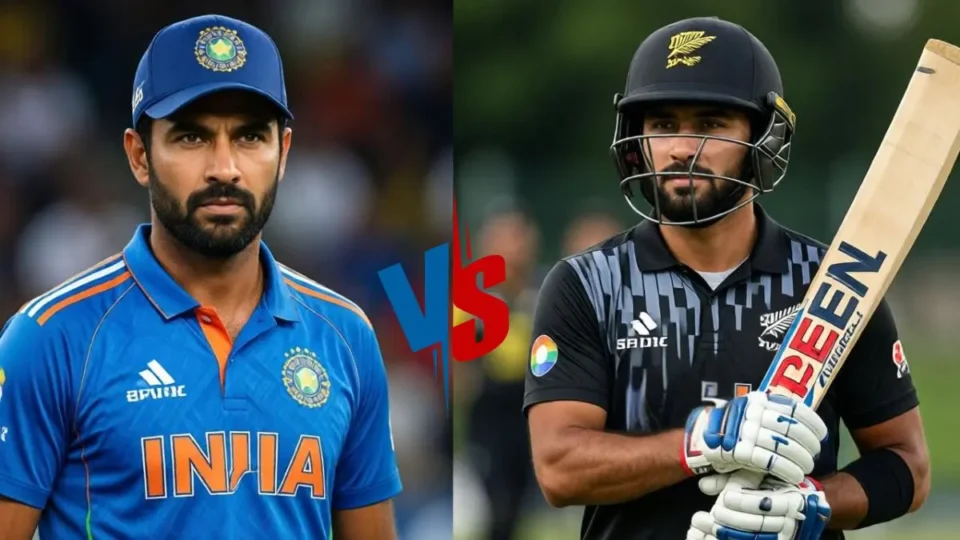
India National Cricket Team vs New Zealand National Cricket Team Stats
| Format | Match | India W | New Zealand W | Drawn |
| Test | 65 | 22 | 16 | 27 |
| ODI | 123 | 63 | 52 | 8 |
| T20I | 25 | 12 | 10 | 3 |
| Overall | 213 | 97 | 78 | 38 |
Present T20 Squad
| India | New Zealand |
| Suryakumar Yadav (C) | James Neesham |
| Sanju Samson (Wk) | Devon Conway (Wk) |
| Axar Patel | Cole McConchie |
| Kuldeep Yadav | Daryl Mitchell |
| Hardik Pandya | Ish Sodhi |
| Jasprit Bumrah | Jacob Duffy |
| Ishan Kishan (Wk) | Mitchell Santner (C) |
| Rinku Singh | Mark Chapman |
| Mohammed Siraj | Matt Henry |
| Washington Sundar | Lockie Ferguson |
| Shivam Dube | Kyle Jamieson |
| Abhishek Sharma | Tim Seifert(Wk) |
| Varun Chakaravarthy | Glenn Phillips |
| Arshdeep Singh | Finn Allen |
| Tilak Varma | Rachin Ravindra |

Another reason this rivalry has grown in importance is its impact on global tournaments. India and New Zealand have clashed in several ICC events, including memorable encounters in World Cups and Champions Trophy tournaments. Matches like the 2019 ICC Cricket World Cup semifinal, where New Zealand defeated India in a dramatic contest, remain etched in cricket history.
Ultimately, the India vs New Zealand rivalry is about more than just wins and losses. It reflects the evolution of modern cricket, where strategy, adaptability, and mental strength often determine the outcome. With both teams consistently ranked among the top sides in the world, every new series adds another compelling chapter to this enduring cricketing story.
Historical Background of India vs New Zealand Matches
The cricketing relationship between India and New Zealand dates back to the early years of international cricket when the sport was expanding beyond its traditional strongholds. Their encounters have evolved from modest bilateral series into high-stakes battles that influence rankings, tournament outcomes, and global cricket narratives.
India first toured New Zealand in 1967–68, marking a significant step in strengthening cricket ties between the two countries. However, the very first official Test match between India and New Zealand was played earlier, in 1955 in Hyderabad. During these early years, both teams were still developing their identities in international cricket. India was striving to establish itself as a competitive Test nation, while New Zealand was working to gain recognition among the elite teams of the sport.
The early decades of this rivalry were characterized by low-scoring matches and cautious gameplay, typical of Test cricket during that era. Batting conditions were challenging, and bowlers often dominated the proceedings. For both teams, victories were hard-earned, and series results frequently ended in draws.
As cricket evolved during the 1970s and 1980s, the rivalry began to gain more momentum. India developed a formidable spin attack featuring bowlers like Bishan Singh Bedi, Erapalli Prasanna, and Bhagwat Chandrasekhar, who could dismantle batting lineups on turning pitches. Meanwhile, New Zealand relied heavily on their legendary all-rounder Sir Richard Hadlee, whose exceptional bowling performances often single-handedly turned matches in his team’s favor.
The introduction of One Day International cricket added a new dimension to the rivalry. ODIs brought faster scoring, aggressive strategies, and the excitement of limited overs. Both teams adapted quickly, and matches between them became increasingly competitive. Fans began witnessing thrilling chases, last-over finishes, and record-breaking innings.
The rivalry reached another level in the modern era, particularly after the rise of the Indian Premier League (IPL) and the increasing popularity of T20 cricket. Many New Zealand players participate in the IPL, building familiarity with Indian conditions and players. This interaction has strengthened the competitive spirit whenever the national teams face off.
Over time, the India–New Zealand rivalry has transformed from a relatively quiet contest into one filled with dramatic narratives and historic moments. Each generation of players has contributed its own stories, making the statistical comparison between the two teams even more fascinating.
Early Encounters Between the Two Nations
The early encounters between India and New Zealand were modest in scale but significant in shaping the long-term relationship between the two cricketing nations. During the 1950s and 1960s, international cricket schedules were far less crowded than they are today. As a result, matches between the two teams were relatively rare, making each series an important milestone.
India hosted New Zealand for their first Test series in 1955–56, a tour that marked the beginning of their official rivalry. The conditions in India proved extremely challenging for the visiting side. Spin-friendly pitches, combined with India’s growing expertise in slow bowling, made batting difficult for the New Zealand players who were more accustomed to seam-friendly surfaces back home.
One of the defining characteristics of these early matches was the dominance of bowlers. Scores were often modest, and innings rarely reached massive totals. The game moved at a slower pace, with teams focusing heavily on defense and patience. In many ways, these matches reflected the traditional spirit of Test cricket—long sessions of careful batting punctuated by moments of brilliance from bowlers.
For India, these encounters provided an opportunity to build confidence as a rising cricket nation. Victories against teams like New Zealand demonstrated that India could compete at the highest level. At the same time, New Zealand gained valuable experience playing in subcontinental conditions, something that would become crucial for future tours.
Despite the competitive nature of the matches, the rivalry between the two teams developed with a strong sense of mutual respect and sportsmanship. Unlike some cricket rivalries that are fueled by intense hostility, India and New Zealand have historically maintained a friendly yet competitive relationship. Players from both sides have often praised each other’s professionalism and dedication to the game.
Another notable aspect of these early encounters was the emergence of talented cricketers who would go on to shape the future of their respective teams. Each series introduced fans to new players capable of producing match-winning performances. These early contests laid the groundwork for what would eventually become a highly respected and statistically rich rivalry in international cricket.
Growth of the Rivalry in the 1990s and 2000s
The 1990s and early 2000s marked a turning point in the cricket rivalry between India and New Zealand. During this period, the game itself was undergoing major transformations. The popularity of One Day International cricket was exploding worldwide, television broadcasting was expanding the sport’s global reach, and players were becoming international superstars. As a result, matches between India and New Zealand began attracting far greater attention from fans and media alike.
India entered the 1990s with one of the most iconic players in cricket history—Sachin Tendulkar. His rise to global fame added enormous excitement to every series India played, including those against New Zealand. Tendulkar’s remarkable ability to score runs in all conditions made him a constant threat to the Kiwi bowlers. Alongside him, players like Sourav Ganguly, Rahul Dravid, and Anil Kumble helped India establish itself as a strong and balanced team.
New Zealand also experienced a golden period during this era. The team featured outstanding players such as Stephen Fleming, Nathan Astle, Chris Cairns, and Daniel Vettori. These cricketers brought a combination of aggressive batting, intelligent captaincy, and versatile bowling that made New Zealand a formidable opponent. Under Fleming’s leadership, the Kiwis developed a reputation for disciplined cricket and clever tactical planning.
The rivalry became particularly interesting in ODI matches, where both teams often produced high-scoring games and thrilling finishes. New Zealand’s ability to adapt to different conditions allowed them to challenge India even in subcontinental venues, while India’s powerful batting lineups could overwhelm opponents on their day.
Another factor that intensified the rivalry was the increasing number of bilateral series and ICC tournaments during this time. The two teams faced each other more frequently, allowing fans to witness developing storylines and recurring player battles. Bowlers like Shane Bond troubled India’s batsmen with sheer pace, while Indian spinners continued to test New Zealand’s technique on turning tracks.
By the end of the 2000s, the India–New Zealand rivalry had firmly established itself as a competitive and entertaining fixture in international cricket. The matches were no longer just routine bilateral games—they had become contests capable of influencing rankings, tournament outcomes, and the global perception of both teams.
ead-to-Head Record Across Formats
When discussing India National Cricket Team vs New Zealand National Cricket Team stats, one of the most important perspectives is the overall head-to-head record across all international formats. Over the decades, the two teams have faced each other hundreds of times in Test matches, One Day Internationals (ODIs), and Twenty20 Internationals (T20Is). These numbers tell a fascinating story about how the rivalry has evolved and how each team has dominated at different periods.
India and New Zealand have played more than 200 international matches across formats, reflecting a long and consistent cricketing relationship. Historically, India has maintained an overall advantage in total wins. However, statistics alone never fully capture the intensity of these contests. Many matches between the two sides have been extremely close, often decided in the final session of a Test match or the last over of a limited-overs game.
One reason the rivalry remains balanced is the contrast in home conditions. India’s pitches generally favor spin bowlers and high-scoring batting conditions once players settle in. New Zealand, on the other hand, offers green pitches that assist swing and seam bowling, especially in cities like Wellington, Christchurch, and Hamilton. As a result, visiting teams often struggle to adapt quickly.
A snapshot of the overall rivalry looks something like this:
| Format | Match | India W | New Zealand W | Draw |
|---|---|---|---|---|
| Test | 65 | 22 | 16 | 27 |
| ODI | 123 | 63 | 52 | 8 |
| T20I | 25+ | 12 | 10 | 3 |
| Overall | 213+ | 97+ | 78+ | 38+ |
These numbers illustrate that while India has a stronger overall win record, New Zealand has consistently challenged them, particularly in major tournaments and knockout matches.
Interestingly, the modern era has seen New Zealand become one of India’s toughest opponents in ICC events. The Kiwis’ victory over India in the 2019 ICC World Cup semifinal and the 2021 ICC World Test Championship final demonstrated their ability to perform under pressure. Those matches significantly shifted how analysts and fans view the rivalry.
Another intriguing element of the statistics is how different players have influenced the results. Indian batsmen have often dominated run-scoring charts, while New Zealand bowlers—especially their seam attack—have produced match-winning spells. This balance between batting brilliance and bowling discipline keeps the rivalry unpredictable.
Overall, the head-to-head record shows a rivalry built on mutual competitiveness rather than one-sided dominance. Even when one team appears stronger on paper, the matches frequently deliver surprises, making every India vs New Zealand series eagerly anticipated by cricket fans around the world.
Test Match Statistics Between India and New Zealand
The Test format remains the most traditional and prestigious form of cricket, and the rivalry between India and New Zealand in Tests has produced some of the most memorable moments in their shared history. Since their first Test encounter in 1955, the two teams have played over 60 Test matches, creating a rich archive of statistics, records, and unforgettable performances.
Historically, Test matches between India and New Zealand have been characterized by dramatically different playing conditions depending on the host country. In India, slow pitches and intense heat often challenge visiting teams. Spinners come into play as the match progresses, and batting requires patience and technical skill. In contrast, New Zealand’s pitches usually offer movement for fast bowlers, especially during the early sessions of a match.
India has traditionally performed strongly at home in Tests against the Kiwis. Cities like Mumbai, Chennai, and Ahmedabad have witnessed several Indian victories where spin bowlers played decisive roles. Legendary players such as Anil Kumble, Harbhajan Singh, and Ravichandran Ashwin have repeatedly troubled New Zealand batsmen on turning tracks.
Meanwhile, New Zealand has often used their home advantage effectively. The swing-friendly conditions allow bowlers like Richard Hadlee, Trent Boult, Tim Southee, and Neil Wagner to exploit the weaknesses of visiting batsmen. Even world-class Indian players have occasionally struggled against the relentless seam movement in New Zealand.
Another fascinating aspect of their Test rivalry is the presence of numerous drawn matches, especially in earlier decades. Test cricket in the past often involved cautious batting and defensive strategies, which sometimes resulted in games ending without a winner. However, modern cricket has become more aggressive, reducing the number of draws and producing more decisive results.
The rivalry also reached a historic milestone in 2021, when India and New Zealand faced each other in the ICC World Test Championship Final at Southampton. New Zealand emerged victorious, securing their first major ICC title in over two decades. That match symbolized the evolving balance of power between the two teams in the longest format.
Test statistics between India and New Zealand therefore represent more than just numbers. They reflect the changing strategies, playing styles, and cricketing philosophies of two nations that have continued to push each other to higher levels of performance.
Highest and Lowest Team Totals in Tests
Team totals are often one of the most revealing statistics in Test cricket. They illustrate how well a batting lineup can dominate or how effectively a bowling attack can dismantle an opponent. In the India vs New Zealand Test rivalry, several remarkable totals—both high and low—have become part of cricketing history.
The highest team total recorded in a Test match between these two sides belongs to New Zealand, who scored 680/8 declared at Wellington in 2014. This massive total was built on outstanding batting performances and demonstrated New Zealand’s ability to dominate even against a traditionally strong Indian bowling attack. Long partnerships and patient batting allowed the Kiwis to pile up runs and put India under enormous pressure.
India’s highest total against New Zealand came when they scored 583/7 declared at Ahmedabad in 1999. That innings showcased India’s powerful batting depth during an era when players like Sachin Tendulkar, Rahul Dravid, and Sourav Ganguly were at their peak. Large totals like this often reflect not only individual brilliance but also excellent team coordination, where multiple players contribute significant scores.
At the opposite end of the spectrum are the lowest team totals, which often occur when bowlers dominate the match completely. India’s lowest total against New Zealand in Tests is 46 runs at Bengaluru in 2024, a shocking collapse that stunned fans and analysts alike. Cricket is full of unpredictable moments, and even the strongest batting lineups can occasionally suffer dramatic failures.
New Zealand’s lowest total against India came when they were bowled out for 62 runs at Wankhede Stadium in 2021. That match highlighted the devastating impact that spin bowlers can have on subcontinental pitches. The Indian bowlers exploited the conditions perfectly, leading to a rapid collapse of the Kiwi batting lineup.
These extremes—huge totals and sudden collapses—illustrate the unpredictable nature of Test cricket. Conditions, player form, and match situations can all influence outcomes dramatically. When India and New Zealand meet in Tests, fans know that anything is possible, from marathon batting sessions to devastating bowling spells.
Legendary Batting Performances in Tests
Throughout the history of India vs New Zealand Test matches, several batsmen have delivered extraordinary performances that still resonate with cricket fans. These innings often occur under intense pressure, where patience, technique, and mental strength become just as important as raw talent.
One of the standout names in this rivalry is Rahul Dravid, widely known as “The Wall.” Dravid scored 1,659 Test runs against New Zealand, making him one of the most successful Indian batsmen against the Kiwis. His calm temperament and exceptional defensive technique made him extremely difficult to dismiss, particularly in challenging conditions.
For New Zealand, Brendon McCullum stands out as one of the most influential batsmen against India. McCullum accumulated 1,224 runs in Test matches against India and played several memorable innings. Known for his aggressive style, he often turned matches around with fearless stroke play.
Another notable record belongs to Vinod Mankad, who scored 231 runs in a single Test innings against New Zealand in 1956. For many years, this remained one of the highest individual scores in the rivalry. Mankad’s innings demonstrated remarkable endurance and concentration, qualities that define great Test batting.
Modern players have also contributed to the legacy. Kane Williamson, New Zealand’s elegant captain, has consistently performed well against India, displaying impeccable technique and patience. On the Indian side, players like Virat Kohli and Rohit Sharma have produced match-defining innings in recent years.
These legendary batting performances highlight the individual brilliance that often defines cricket rivalries. While team victories matter most, unforgettable innings from star players become lasting memories that fans cherish for decades.
Best Bowling Figures in Test Matches
While batsmen often capture the spotlight with centuries and double centuries, bowlers have played an equally critical role in shaping the India vs New Zealand Test rivalry. Some of the most dramatic moments in these matches have come from devastating bowling spells that completely changed the course of a game.
Among Indian bowlers, Ravichandran Ashwin stands out as one of the most successful against New Zealand. With over 75 Test wickets against the Kiwis, Ashwin has repeatedly demonstrated his mastery of spin bowling. His ability to vary pace, flight, and turn makes him particularly dangerous on Indian pitches.
New Zealand’s bowling legacy against India is equally impressive. The legendary Sir Richard Hadlee was a nightmare for Indian batsmen during the 1970s and 1980s. Hadlee combined precision, swing, and relentless accuracy, allowing him to dismantle batting lineups even in difficult conditions.
In the modern era, bowlers such as Trent Boult and Tim Southee have continued New Zealand’s tradition of exceptional seam bowling. Their ability to generate swing with the new ball has troubled even the most experienced Indian batsmen.
One remarkable statistic in this rivalry is the number of five-wicket hauls achieved by bowlers from both sides. These performances often determine the outcome of Test matches because they can trigger dramatic collapses or prevent opposing teams from building large totals.
Bowling excellence in this rivalry highlights an important truth about cricket: while great batting wins admiration, great bowling wins matches. The India vs New Zealand rivalry has consistently showcased bowlers who possess not only skill but also the mental toughness required to perform at the highest level.
ODI Rivalry Breakdown
The One Day International (ODI) rivalry between the India National Cricket Team and the New Zealand National Cricket Team has produced some of the most exciting moments in limited-overs cricket. Since their first ODI encounter in 1975 during the inaugural Cricket World Cup, the two teams have faced each other in more than 120 matches, creating a long statistical record filled with memorable games, dramatic chases, and extraordinary individual performances.
India has historically maintained a slight advantage in overall ODI victories against New Zealand. However, statistics alone cannot fully capture the competitive balance between these two sides. New Zealand has often surprised India with tactical brilliance, disciplined bowling, and outstanding fielding performances. In fact, many cricket experts consider New Zealand one of the most tactically intelligent teams in the ODI format.
One key factor influencing ODI results between these teams is the difference in playing conditions. Indian pitches often favor batting and spin bowling, while New Zealand conditions support fast bowlers and swing. This contrast means visiting teams must quickly adapt their strategies. Indian batsmen must deal with the swing-friendly conditions in cities like Wellington and Christchurch, while New Zealand players must learn how to handle spin-heavy attacks in venues such as Chennai or Delhi.
Another interesting aspect of the ODI rivalry is the evolution of scoring patterns. During the 1980s and early 1990s, scores of 220–240 runs were considered competitive totals. Today, however, the modern game has shifted dramatically. With improved bats, aggressive batting strategies, and power-hitting techniques, teams now regularly score 300+ runs in matches between India and New Zealand.
Several legendary players have shaped the ODI rivalry. For India, icons like Sachin Tendulkar, MS Dhoni, Rohit Sharma, and Virat Kohli have played defining roles. Their ability to anchor innings and accelerate when needed has led India to numerous victories. Meanwhile, New Zealand legends such as Ross Taylor, Kane Williamson, Martin Guptill, and Brendon McCullum have delivered powerful performances that challenged India’s dominance.
ODI matches between these two teams often showcase a balance between aggressive batting and clever bowling. A team may dominate for most of the match, only to see the momentum shift suddenly due to a brilliant spell of bowling or a stunning batting partnership.
What makes this rivalry even more compelling is its frequent impact on ICC tournaments. Several high-stakes ODI matches between India and New Zealand have taken place in global competitions, ensuring that their encounters remain among the most eagerly anticipated fixtures in international cricket.
India vs New Zealand in ICC World Cups
The ICC Cricket World Cup has been the stage for some of the most unforgettable matches between India and New Zealand. Unlike bilateral series, World Cup games carry immense pressure because a single defeat can end a team’s chances of lifting the trophy. As a result, encounters between these two teams in World Cups often become historic moments remembered for years.
India and New Zealand first met in the 1975 Cricket World Cup, the very first edition of the tournament. In that match, New Zealand emerged victorious, signaling early on that they could challenge stronger teams on the global stage. Over the years, both teams have continued to face each other in several World Cup tournaments, each meeting adding another chapter to their rivalry.
One of the most dramatic encounters came during the 2019 ICC Cricket World Cup semifinal held at Old Trafford in Manchester. India entered the match as one of the tournament favorites, boasting a powerful batting lineup and an excellent bowling attack. New Zealand, however, delivered a disciplined performance. Their bowlers dismantled India’s top order, and despite a valiant effort from MS Dhoni and Ravindra Jadeja, India fell short of the target.
That semifinal remains one of the most emotionally intense matches for Indian fans. For New Zealand supporters, it was a moment of pride as their team reached another World Cup final through determination and teamwork. The match demonstrated how the Kiwis often excel in high-pressure knockout situations, even when facing stronger opponents.
Another memorable World Cup clash occurred during the 2003 tournament, when India defeated New Zealand in a crucial group-stage match. That victory helped India build momentum on their journey to the final that year.
These World Cup encounters highlight a fascinating dynamic: while India may have stronger overall statistics in ODIs, New Zealand has frequently delivered remarkable performances in ICC tournament matches. Their ability to remain calm under pressure and execute clear strategies has earned them a reputation as giant-killers in global competitions.
Record-Breaking Individual Performances in ODIs
Individual brilliance has always played a major role in shaping the India vs New Zealand ODI rivalry. Over the years, numerous players from both teams have produced record-breaking performances that not only influenced match results but also became part of cricket folklore.
One of the most impressive records belongs to Sachin Tendulkar, who scored 1,750 ODI runs against New Zealand during his illustrious career. Tendulkar’s ability to adapt to different conditions allowed him to perform consistently against the Kiwi bowling attack. Whether playing on Indian pitches or in the challenging conditions of New Zealand, he often delivered crucial innings for his team.
For New Zealand, Ross Taylor stands as the highest run-scorer against India in ODIs, accumulating 1,385 runs. Taylor’s elegant batting style and ability to accelerate during the middle overs made him a key figure in New Zealand’s batting lineup for many years. His performances against India frequently helped the Kiwis remain competitive even against strong bowling attacks.
Another remarkable achievement came from Shubman Gill, who scored a stunning 208 runs in an ODI against New Zealand in 2023. This double century highlighted the new generation of Indian batsmen capable of dominating international cricket with fearless stroke play.
New Zealand also boasts impressive individual innings, such as Tom Latham’s unbeaten 145, which showcased his calm and composed batting under pressure. Performances like these often become turning points in matches, especially when they occur during difficult situations.
Bowling records are equally significant. Indian fast bowler Javagal Srinath claimed 51 ODI wickets against New Zealand, making him one of the most successful bowlers in this rivalry. On the other hand, New Zealand’s Tim Southee has taken more than 38 wickets against India, frequently troubling Indian batsmen with his swing and accuracy.
These record-breaking performances demonstrate how individual players can shape the outcome of matches. While cricket remains a team sport, moments of brilliance from exceptional players often define the legacy of great rivalries.
T20I Rivalry Between India and New Zealand
The Twenty20 International (T20I) format has added a modern and explosive dimension to the rivalry between India and New Zealand. Introduced in the mid-2000s, T20 cricket dramatically changed how the game is played. Matches are shorter, scoring rates are higher, and players must adapt quickly to fast-paced situations. As a result, encounters between India and New Zealand in T20Is often produce thrilling contests filled with big hits, dramatic finishes, and unexpected outcomes.
India and New Zealand have played over 25 T20I matches against each other, and the rivalry remains relatively balanced. Unlike in Tests or ODIs where historical trends are clearer, T20 matches tend to be unpredictable. A single over of explosive batting or a brilliant bowling spell can completely change the result of the game.
India has often relied on its powerful batting lineup in T20 cricket. Players like Rohit Sharma, Virat Kohli, Suryakumar Yadav, and Hardik Pandya bring immense firepower to the format. Their ability to score quickly during the powerplay and death overs makes India one of the most dangerous teams in T20 internationals.
New Zealand, meanwhile, approaches the format with strategic discipline. Their players emphasize smart shot selection, excellent fielding, and effective bowling variations. Cricketers such as Kane Williamson, Glenn Phillips, Martin Guptill, and Jimmy Neesham have played key roles in several T20 victories against India.
The rivalry also intensified during the 2021 ICC T20 World Cup, where New Zealand defeated India in the group stage. That victory significantly affected India’s chances of reaching the semifinals and once again highlighted New Zealand’s ability to perform well in major tournaments.
T20 matches between these teams often feature high-scoring encounters. India once posted 234/4 against New Zealand in Ahmedabad in 2023, one of the highest totals in their T20 rivalry. These matches demonstrate how modern cricket prioritizes aggressive batting and innovative strategies.
Ultimately, the T20I rivalry reflects the changing nature of cricket. It combines traditional cricketing skills with modern entertainment, creating matches that appeal to both dedicated fans and new audiences.
Modern Era Stars Dominating T20I Matches
The modern era of T20 cricket has introduced a new generation of players who continue to shape the India vs New Zealand rivalry. These stars bring innovative techniques, fearless batting, and strategic bowling approaches that make T20 matches particularly exciting to watch.
One of the most influential players in this format is Rohit Sharma, who has scored over 500 T20I runs against New Zealand. Known for his elegant yet powerful batting, Rohit can change the momentum of a match within a few overs. His ability to hit sixes effortlessly makes him a constant threat to opposing bowlers.
Another standout performer is Colin Munro from New Zealand, who has scored more than 400 runs against India in T20Is. Munro’s aggressive batting style perfectly suits the fast-paced nature of the format. His explosive innings have often given New Zealand strong starts in matches against India.
Indian batsman Shubman Gill also made headlines by scoring 126 runs in a T20I against New Zealand, one of the highest individual scores in their rivalry. Such performances highlight how the younger generation is continuing the legacy established by earlier cricket legends.
Bowling remains equally important in T20 cricket. Indian fast bowler Jasprit Bumrah has taken more than 12 wickets against New Zealand, using his unique bowling action and deadly yorkers to restrict scoring during crucial moments. For New Zealand, spinner Ish Sodhi has claimed over 25 wickets against India, often breaking important partnerships.
The performances of these modern stars demonstrate how the rivalry continues to evolve. With each series, new players emerge to create memorable moments that add to the growing history between the two cricketing nations.
Memorable Matches Between India and New Zealand
Over the decades, several matches between India and New Zealand have stood out as truly unforgettable contests. These games are remembered not just for their results but for the dramatic moments, incredible performances, and emotional reactions they generated among fans.
One of the most iconic matches remains the 2019 ICC World Cup semifinal. Rain interruptions spread the match across two days, creating enormous tension for players and spectators alike. New Zealand posted a challenging total, and their bowlers then delivered an outstanding performance to reduce India’s top order to a shocking collapse. Although Ravindra Jadeja and MS Dhoni fought bravely to revive India’s chances, New Zealand eventually secured victory by 18 runs.
Another memorable contest occurred during the 2020 T20I series, where India defeated New Zealand in multiple matches that went to Super Overs. These dramatic finishes showcased the nerve and skill required in modern cricket. Fans witnessed intense pressure situations where a single boundary could decide the outcome.
In Test cricket, the 2021 World Test Championship Final remains a landmark event. Played in Southampton, the match represented the culmination of two years of Test cricket competition. New Zealand’s disciplined bowling attack and composed batting performance helped them defeat India and claim the historic title.
These memorable matches highlight why the India vs New Zealand rivalry remains so captivating. Each game has the potential to produce moments that cricket fans will remember for decades.
Conclusion
The rivalry between the India National Cricket Team and the New Zealand National Cricket Team is one of the most fascinating and respected contests in international cricket. Unlike some rivalries fueled by hostility or historical tensions, the competition between these two teams is defined by mutual respect, professionalism, and a shared commitment to high-quality cricket.
From their first meeting in 1955 to the modern era of T20 cricket, India and New Zealand have built a rivalry rich in statistics, unforgettable performances, and dramatic matches. The numbers reveal a competitive balance: India holds a stronger overall record, particularly in home conditions, while New Zealand has repeatedly demonstrated its ability to challenge and defeat India in crucial matches, especially during ICC tournaments.
Legendary players from both sides have shaped the narrative of this rivalry. Icons like Sachin Tendulkar, Rahul Dravid, and Virat Kohli have delivered remarkable batting performances for India, while New Zealand stars such as Kane Williamson, Ross Taylor, and Brendon McCullum have created their own legacy through skill and determination. Bowlers—from Richard Hadlee to Ravichandran Ashwin—have also played vital roles in deciding matches.
Perhaps the most remarkable aspect of this rivalry is its unpredictability. Conditions, strategy, and individual brilliance can dramatically change the outcome of any match between these teams. Whether it is a five-day Test battle, a high-scoring ODI, or a thrilling T20 encounter, India vs New Zealand games consistently offer excitement and competitive drama.
As cricket continues to evolve, new generations of players will carry this rivalry forward. With both teams remaining among the top contenders in international cricket, future matches promise even more memorable moments and statistical milestones.
FAQs
1. How many times have India and New Zealand played against each other in international cricket?
India and New Zealand have played over 200 international matches across Tests, ODIs, and T20Is combined. Their rivalry dates back to 1955 and continues to grow with every series.
2. Who has scored the most runs in India vs New Zealand matches?
Among Indian players, Sachin Tendulkar holds one of the highest run totals against New Zealand in ODIs, while Rahul Dravid leads the run charts in Test matches between the two teams.
3. Which bowler has taken the most wickets in the India vs New Zealand rivalry?
Indian spinner Ravichandran Ashwin and New Zealand legend Sir Richard Hadlee are among the most successful bowlers in matches between the two nations.
4. What was the most famous match between India and New Zealand?
The 2019 ICC Cricket World Cup semifinal is widely regarded as one of the most famous matches, where New Zealand defeated India in a dramatic contest.
5. Who won the ICC World Test Championship Final between India and New Zealand?
New Zealand won the 2021 ICC World Test Championship Final, defeating India at Southampton to claim the inaugural WTC title.
