
India National Cricket Team vs Zimbabwe National Cricket Team Standings
Super 8s – Group
| Pl | W | L | P | RR | |
| South Africa (Q) | 3 | 3 | 0 | 6 | +2.259 |
| India (Q) | 3 | 2 | 1 | 4 | +0.106 |
| West Indies | 3 | 1 | 2 | 2 | +0.993 |
| Zimbabwe | 3 | 0 | 3 | 0 | -3.415 |
Head-to-Head
| Format | Match | Ind W | Zim W | Tied |
| Test | 11 | 7 | 2 | 2 |
| ODI | 66 | 54 | 10 | 2 |
| T20I | 14 | 11 | 3 | 0 |
| Total | 91 | 72 | 15 | 4 |

Cricket rivalries are often painted in bold colors — fierce competition, dramatic finishes, and unforgettable individual brilliance. When we talk about the India National Cricket Team vs Zimbabwe National Cricket Team standings, it may not immediately spark the same intensity as some of cricket’s more high-profile clashes. But here’s the thing: numbers don’t lie, and history tells a compelling story.
On paper, India has dominated Zimbabwe across formats. Yet, if you peel back the layers, you’ll discover something more interesting than just wins and losses. You’ll find growth, resilience, rebuilding phases, generational shifts, and moments where Zimbabwe punched well above its weight. You’ll see how India evolved from a competitive side into a cricketing powerhouse. And you’ll understand how standings reflect not just performance, but momentum, psychology, and future direction.
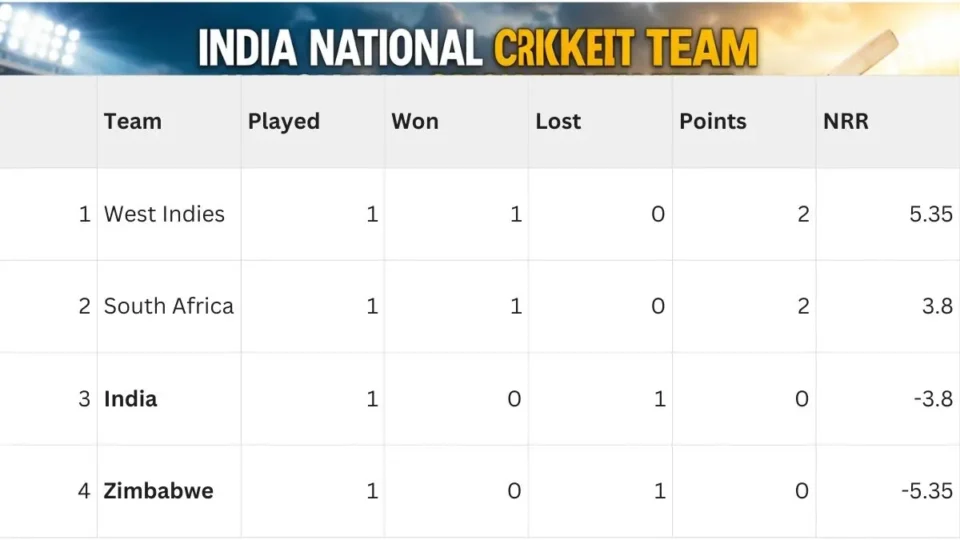
The latest standings show West Indies and South Africa leading with 2 points each, while India and Zimbabwe currently sit without points after one match. India’s Net Run Rate (NRR) stands at -3.800, while Zimbabwe’s is -5.350. These numbers may look small, but in tournament cricket, they can decide qualification and eliminate teams faster than you expect.
Standings are more than statistics. They are snapshots of form, pressure, strategy, and execution. So let’s dive deep into the India vs Zimbabwe rivalry — across Tests, ODIs, and T20Is — and explore what the standings truly reveal about these two cricketing nations.
Current Tournament Standings Overview
At first glance, the current points table seems straightforward. West Indies and South Africa each have 2 points from one match, while India and Zimbabwe are yet to open their account. But cricket tournaments are rarely simple. One game can flip everything.
Here’s the breakdown:
| T | M | W | L | N/R | P | NRR | |
| 1 | South Africa (Q) | 2 | 2 | 0 | 0 | 4 | +2.890 |
| 2 | West Indies | 2 | 1 | 1 | 0 | 2 | +1.791 |
| 3 | India | 2 | 1 | 1 | 0 | 2 | -0.100 |
| 4 | Zimbabwe (E) | 2 | 0 | 2 | 0 | 0 | -4.475 |
What jumps out immediately? Net Run Rate. India’s -3.800 is significantly better than Zimbabwe’s -5.350, which could prove crucial if both teams finish with equal points later in the tournament.
A single heavy defeat can hurt more than just morale. It dents your NRR, which is essentially a tie-breaker in disguise. Think of it like goal difference in football. It quietly waits in the background until suddenly it becomes the deciding factor.
For India, the pressure is manageable. They have depth, experience, and tournament know-how. Zimbabwe, however, faces a steeper climb. Every upcoming match becomes a must-win situation, and not just a narrow victory — they may need commanding performances to repair their NRR.
Standings aren’t permanent. They’re fluid. One explosive batting display or one dominant bowling spell can turn the table upside down.
Head-to-Head Record Across All Formats
Numbers tell stories, and the head-to-head record between India and Zimbabwe speaks clearly. Across 90 total matches in international cricket, India has won 71 times. Zimbabwe has managed 15 wins, with 4 matches ending in ties or no results.
Here’s the overall summary:
| Total M | Ind W | Zim W | Tie | |
|---|---|---|---|---|
| Test | 11 | 7 | 2 | 2 |
| ODI | 66 | 54 | 10 | 2 |
| T20I | 13 | 10 | 3 | 0 |
| Overall | 90 | 71 | 15 | 4 |
That’s a commanding lead for India. But let’s slow down for a moment. Cricket isn’t just about volume of wins — it’s about context.
Zimbabwe’s victories often came during transitional phases for India or during periods when Zimbabwe itself was a competitive mid-tier team with strong individual performers. Remember, Zimbabwe in the late 1990s and early 2000s was no pushover. They had players capable of dismantling even top-tier teams.
India’s dominance, especially in ODIs, reflects consistency and squad depth. Winning 54 out of 66 matches isn’t accidental. It shows structural strength, financial backing, grassroots development, and exposure to high-pressure tournaments.
However, in cricket, history doesn’t guarantee future results. Every new series resets the narrative. Zimbabwe may trail heavily in numbers, but cricket remains gloriously unpredictable.
And that unpredictability is what keeps this rivalry alive.
Test Matches: A Red-Ball Story
Test cricket is the ultimate examination — five days, red ball, shifting conditions, and mental endurance. Between India and Zimbabwe, 11 Test matches have been played. India has won 7, Zimbabwe 2, and 2 ended in draws.
At first glance, India clearly dominates. But let’s look deeper.
Zimbabwe’s two Test wins came during a time when they were tactically sharp and fearless. Test cricket doesn’t allow flukes. To win, you must outperform across multiple sessions — batting discipline, bowling consistency, fielding precision. Zimbabwe proved, at least on those occasions, that they could match India over the long haul.
India’s seven victories, however, underline technical superiority and depth. Indian batsmen traditionally excel against spin, and Zimbabwean conditions often mirror subcontinental pitches — slow turners, variable bounce. That familiarity gave India an edge.
But beyond conditions, Test cricket also reveals mental stamina. India’s ability to control sessions, build partnerships, and grind opposition bowlers into fatigue has been a hallmark of their red-ball approach.
Zimbabwe’s challenge has often been sustaining performance across five days. A strong first innings would sometimes be followed by batting collapses or bowling fatigue.
Yet Test cricket between these two sides carries a certain charm. There’s less noise, less hype — just pure cricket. And in that purity, both teams have produced moments worth remembering.
ODI Matches: India’s Dominance in the 50-Over Format
If Test cricket is a marathon, One Day Internationals are more like a strategic chess match played at double speed. And when it comes to ODIs between India and Zimbabwe, the numbers are emphatic. Out of 66 matches played, India has won 54, while Zimbabwe has claimed victory in 10. Two games ended in ties or no results. That’s not just dominance — that’s structural superiority.
But why has India been so commanding in the 50-over format?
First, depth. India’s ODI system has consistently produced technically sound top-order batters and world-class middle-order finishers. Over the decades, from the era of Sachin Tendulkar and Sourav Ganguly to the reign of MS Dhoni, and now Rohit Sharma and Virat Kohli, India has rarely struggled to build or chase big totals. Zimbabwe, on the other hand, has often relied heavily on a handful of experienced players. When those key figures performed, Zimbabwe looked competitive. When they failed, collapses followed.
Second, bowling variety. India traditionally fields a balanced attack — quality pacers, wrist spinners, finger spinners, and reliable death bowlers. Zimbabwe has had strong bowlers in patches, but maintaining consistency over 50 overs has often been a challenge.
Third, adaptability. ODI cricket demands flexibility — shifting gears from cautious to aggressive within overs. India mastered this art. Zimbabwe has shown flashes of brilliance, but sustaining it across 50 overs has been difficult.
Still, those 10 Zimbabwe wins matter. They prove something important: when Zimbabwe executes well, they can surprise India. Cricket doesn’t run on reputation. It runs on performance — one ball at a time.
Iconic ODI Performances
Numbers fade, but performances live forever. Some ODI encounters between India and Zimbabwe have produced moments that fans still remember.
Think about explosive centuries that turned games upside down. Indian batters have often used Zimbabwean attacks to showcase dominance, scoring big hundreds with elegance and authority. These innings weren’t just about power — they were about timing, placement, and patience. Zimbabwean bowlers were frequently put under relentless pressure, fielders pushed to the boundary again and again.
But Zimbabwe has had its heroes too.
There were matches where Zimbabwe defended modest totals through disciplined bowling. Tight lines, clever variations, and sharp fielding forced India into uncomfortable positions. On certain days, Indian batting collapses opened the door for Zimbabwean upsets.
ODIs are fascinating because they balance risk and reward. Go too hard too early, and you collapse. Play too safe, and you fall short. India has generally managed this balance better. Their game awareness — knowing when to accelerate, when to rotate strike, when to attack — has been superior.
Yet cricket’s beauty lies in unpredictability. Even with a 54-10 win ratio, each new ODI begins at 0-0. And that’s why the rivalry continues to matter.
T20I Matches: The Modern-Day Showdown
Now let’s talk about the shortest and most explosive format — T20 Internationals. Here, India again leads comfortably: 10 wins out of 13 matches, while Zimbabwe has managed 3 victories.
T20 cricket is ruthless. There’s no time to recover from mistakes. One poor over can cost 20 runs. One batting collapse can end the game inside the powerplay. It’s chaos packaged into three hours.
India’s dominance in T20Is against Zimbabwe reflects their adaptability to modern cricket. With the rise of franchise leagues and high-pressure tournaments, Indian players have gained extensive T20 exposure. They understand pacing, match-ups, and data-driven strategies.
Zimbabwe, though less experienced at the global franchise level, has shown flashes of fearless cricket. Their three victories weren’t accidents. They came from aggressive batting and disciplined bowling — proof that in T20, the gap narrows quickly.
Unlike Tests and ODIs, T20 doesn’t always reward historical strength. It rewards momentum. Zimbabwe’s biggest advantage in this format? Freedom. When expectations are low, players often perform with less pressure.
India’s challenge in T20 is different. They carry expectation. Every loss is scrutinized. Every win is analyzed. That weight can be heavy.
Still, a 10-3 record speaks volumes. India has handled the format better overall, combining aggressive power-hitting with calculated bowling plans.
Explosive T20 Moments Between India and Zimbabwe
T20 matches between these two sides have delivered thrilling moments. Powerplay blitzes, last-over finishes, surprise bowling spells — this format compresses drama into tight spaces.
There have been matches where Indian openers demolished the bowling inside six overs, chasing targets before Zimbabwe could settle. Sixes flying into the stands, boundaries piercing gaps like arrows — it looked effortless.
But Zimbabwe has had its fireworks too.
Occasionally, Zimbabwean batters have attacked Indian spinners fearlessly, stepping out of the crease, clearing long-on and long-off. Those matches remind everyone that talent exists everywhere. Confidence is the only missing ingredient sometimes.
Bowling, too, has produced surprises. A clever slower ball here. A well-directed yorker there. T20 is about margins — a few centimeters can separate a dot ball from a boundary.
The 10-3 record suggests control. But T20 cricket always carries risk. And risk keeps fans glued to their screens.
Overall Statistical Comparison
Looking at the complete picture — 90 matches across formats — India’s 71 wins compared to Zimbabwe’s 15 paints a dominant portrait. But statistics must be interpreted carefully.
Let’s break it down numerically:
-
India win percentage: 78.9%
-
Zimbabwe win percentage: 16.7%
-
Draw/Tie/No Result: 4.4%
These numbers reveal a clear hierarchy. Yet cricket development isn’t linear. Zimbabwe has experienced administrative challenges, financial struggles, and player migrations over the years. India, meanwhile, built one of the strongest domestic structures globally.
Success in international cricket often mirrors investment at grassroots levels. India’s extensive domestic tournaments — Ranji Trophy, IPL, youth circuits — create a talent pipeline. Zimbabwe’s smaller system naturally limits depth.
However, statistics don’t measure heart. Zimbabwe’s resilience despite structural challenges deserves acknowledgment. Competing against a cricketing giant and still securing 15 wins shows grit.
Numbers show dominance. Context shows courage.
Batting Strength Analysis
India’s batting strength against Zimbabwe has historically been overwhelming. Technically sound openers, stabilizing middle-order batters, and explosive finishers form a complete package.
Indian batters traditionally play spin well, rotate strike efficiently, and build partnerships. That partnership-building ability is crucial. Cricket matches are rarely won by isolated brilliance; they’re won by sustained collaboration.
Zimbabwe, in contrast, has often depended on one or two key batters to anchor innings. When those players delivered, Zimbabwe looked competitive. When early wickets fell, rebuilding became difficult.
Consistency is the dividing line. India has produced multiple centuries across formats against Zimbabwe. Their ability to convert starts into big scores puts bowlers under prolonged stress.
But Zimbabwe’s batting cannot be dismissed. On flat pitches, with confidence flowing, Zimbabwean batters can score quickly and disrupt rhythm.
Batting, at its core, is psychological. If Zimbabwe can build belief early in innings, pressure shifts. And pressure changes everything.
Bowling Performance Comparison
Bowling wins tournaments. That saying holds true even in this rivalry.
India’s bowling attack across formats has generally offered more variety. Seamers who swing the new ball. Spinners who exploit middle overs. Death bowlers who execute yorkers under pressure. That layered attack structure makes scoring difficult at different phases.
Zimbabwe has produced quality bowlers — especially seamers capable of hitting hard lengths. But depth has often been the challenge. After frontline bowlers complete their spells, containing runs becomes harder.
Economy rate, strike rate, and consistency favor India historically. They’ve been better at breaking partnerships and applying pressure in clusters.
Yet bowling remains cricket’s great equalizer. One inspired spell can tilt a match dramatically. Zimbabwe’s victories against India often featured exactly that — a bowler stepping up, refusing to back down.
Fielding Standards and Match Awareness
Fielding rarely dominates headlines, but it wins games quietly.
India’s athleticism has improved significantly over the last decade. Quick outfield coverage, sharp throws, diving stops — these small contributions reduce 20-30 runs per match. That’s massive.
Zimbabwe has shown commitment in the field, but consistency has varied. Missed chances in close matches have sometimes proved costly.
Match awareness — knowing when to push for a second run, when to slow the tempo, when to attack — separates good teams from great ones. India’s experience in high-pressure tournaments gives them a slight edge here.
Conclusion: Beyond Statistics, A Story of Growth
The India National Cricket Team vs Zimbabwe National Cricket Team standings reflect dominance, but they also reflect evolution. India’s 71 wins out of 90 matches highlight structural strength, consistency, and depth. Zimbabwe’s 15 victories, meanwhile, symbolize resilience and moments of brilliance against a cricketing powerhouse.
Current standings show India and Zimbabwe searching for their first points in the ongoing competition. Net Run Rate may soon become decisive. Momentum can shift quickly.
Cricket doesn’t remember only winners. It remembers effort, heart, and transformation. Zimbabwe continues to rebuild. India continues to refine.
And every time these two teams meet, the scoreboard resets to zero — reminding us that in cricket, possibility always exists.
FAQs
1. How many total matches have India and Zimbabwe played?
They have played 90 international matches across Tests, ODIs, and T20Is.
2. Who has won more matches between India and Zimbabwe?
India has won 71 matches, while Zimbabwe has won 15, with 4 ties or no results.
3. What is India’s strongest format against Zimbabwe?
India has been particularly dominant in ODIs, winning 54 out of 66 matches.
4. How important is Net Run Rate in current standings?
NRR acts as a tie-breaker when teams have equal points and can determine qualification.
5. Can Zimbabwe compete strongly against India today?
Yes, especially in T20 cricket where shorter formats reduce the performance gap and allow underdogs to surprise stronger teams.
