
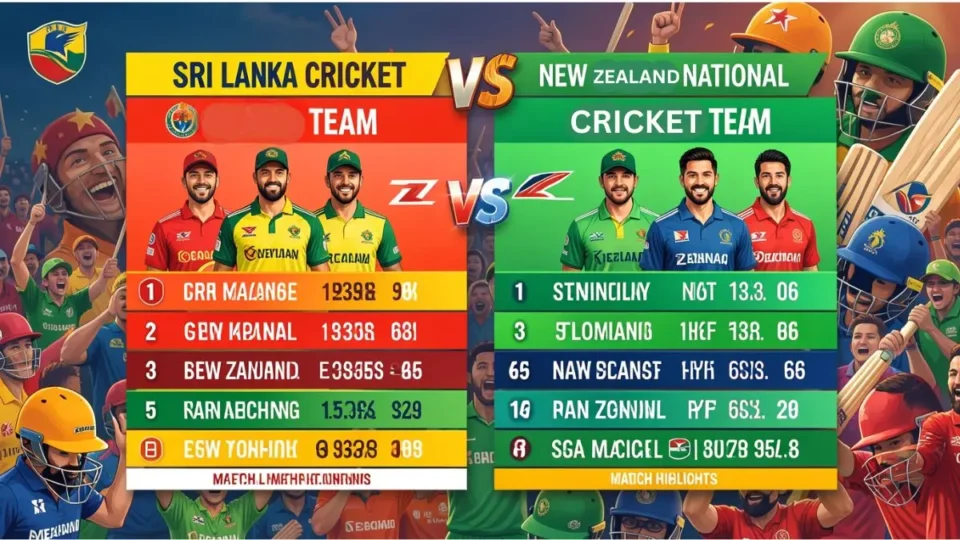
Sri Lanka Cricket Team vs New Zealand National Cricket Team Standings
| P | W | L | P | RR | |
| England (Q) | 3 | 3 | 0 | 6 | +1.096 |
| New Zealand (Q) | 3 | 1 | 1 (1 NR) | 3 | +1.390 |
| Pakistan | 3 | 1 | 1 (1 NR) | 3 | -0.123 |
| Sri Lanka | 3 | 0 | 3 | 0 | -1.950 |
Head-to-Head Overview
New Zealand holds a strong edge over Sri Lanka across formats, winning 22 of 31 T20Is while Sri Lanka has 9 victories. In ODIs, New Zealand leads 54-49 from 108 matches. Sri Lanka’s home advantage in Colombo could shift dynamics.
Match Context
England’s 51-run win over Sri Lanka dented the hosts’ NRR after a strong group stage. New Zealand earned a point from a rainout vs Pakistan. Top two advance; this game is pivotal.
Sri Lanka probable XI: Pathum Nissanka, Kusal Mendis (wk), Kamindu Mendis, Dasun Shanaka (c). New Zealand relies on Tim Seifert (173 runs in tournament) and pacers like Matt Henry. Pitch favors spin; dew may aid chasing.
Early Years of Sri Lanka Cricket
Sri Lanka’s cricket journey is nothing short of inspirational. Before gaining Test status in 1981, Sri Lanka was considered an underdog—passionate, yes, but inexperienced on the global stage. Yet, within a short span, they began redefining expectations. Their crowning moment came in 1996 when they lifted the ICC Cricket World Cup, shocking traditional giants and rewriting cricket history.
Back then, standings didn’t always favor Sri Lanka at the beginning of tournaments. They often started slow. But once they found their rhythm—especially in subcontinent conditions—they climbed the tables rapidly. Players like Aravinda de Silva, Sanath Jayasuriya, and Muttiah Muralitharan became game-changers who could single-handedly swing standings.
Sri Lanka’s rise wasn’t linear. There were ups and downs. Periods of dominance were followed by rebuilding phases. But one thing remained constant: their ability to surprise. In ICC tournaments, they frequently disrupted predicted standings, defeating higher-ranked teams and climbing into knockout rounds.
Their cricket culture revolves around adaptability. Spin-friendly pitches? They dominate. Slow surfaces? They strategize brilliantly. However, away from home, standings often told a tougher story. Overseas tours, particularly in New Zealand conditions, proved challenging.
Yet Sri Lanka’s unpredictability is their strength. When analysts count them out, they tend to respond with unforgettable performances. And that unpredictability plays a major role in standings battles against teams like New Zealand.
Evolution of New Zealand Cricket
New Zealand’s cricket journey is a story of steady growth and quiet excellence. Unlike teams that rely on flair, New Zealand built its reputation on discipline, structure, and unity. For decades, they were considered competitive but not dominant. However, that narrative began changing in the 2000s.
The turning point? Consistency in ICC tournaments. Whether it was the 2015 or 2019 World Cup, New Zealand consistently finished near the top of standings tables. They didn’t always start as favorites, but by the time knockout stages arrived, they were almost always there.
The Black Caps focus heavily on teamwork. From Brendon McCullum’s aggressive leadership era to Kane Williamson’s calm strategic captaincy, New Zealand mastered the art of tournament cricket. Their net run rate management, smart bowling rotations, and composed chases often helped them secure higher standings.
Unlike Sri Lanka’s sometimes explosive style, New Zealand’s approach is methodical. They rarely collapse dramatically. That stability ensures they remain strong contenders in group stages.
Another key factor? Adaptability in foreign conditions. Whether playing in Asia, England, or Australia, New Zealand adjusts quickly. That’s why their standings in global tournaments have improved significantly over the last decade.
So when Sri Lanka meets New Zealand, it becomes a battle between flair and structure. And often, it’s the points table that reflects who executed their plan better.
Head-to-Head Record Overview
When analyzing standings between Sri Lanka and New Zealand, head-to-head statistics offer fascinating insight. Over the decades, both teams have traded victories across formats—Tests, ODIs, and T20Is.
In One Day Internationals, New Zealand has generally maintained a slight edge in recent years, especially in ICC tournaments. However, Sri Lanka dominated several bilateral series during their golden era in the late 1990s and early 2000s.
In T20 cricket, the margin has been narrower. A single explosive innings or a disciplined bowling spell often determines the outcome—and subsequently impacts tournament standings dramatically.
What makes this rivalry unique is its unpredictability. Unlike rivalries where one team dominates consistently, Sri Lanka vs New Zealand has seen momentum shift frequently. In some tournaments, Sri Lanka topped group standings while New Zealand struggled. In others, the roles reversed.
Head-to-head results also show a pattern: home advantage plays a massive role. In Sri Lankan conditions, spin becomes decisive. In New Zealand, pace and swing dictate results.
Ultimately, standings between these two teams aren’t just numbers—they’re reflections of tactical execution, conditions, and mental resilience.

ICC Tournament Standings Comparison
When we talk about the Sri Lanka Cricket Team vs New Zealand National Cricket Team standings, ICC tournaments are where the real drama unfolds. Bilateral series matter, sure—but global tournaments? That’s where legacies are shaped and standings become historic.
Both teams have had memorable campaigns in ICC events. But here’s the interesting twist: New Zealand has built a reputation for consistency, while Sri Lanka has often relied on moments of brilliance. The standings reflect that contrast clearly.
In ICC events, standings are not just about wins and losses—they are about momentum, net run rate (NRR), and how teams perform under extreme pressure. One heavy defeat can damage NRR so badly that it changes the entire group scenario. We’ve seen that happen with both sides.
Let’s break it down format by format.
ODI World Cup Standings
The ODI World Cup has provided some of the most unforgettable chapters in Sri Lanka vs New Zealand history.
Sri Lanka’s biggest World Cup achievement came in 1996 when they lifted the trophy. During that tournament, they climbed the standings steadily, defeating strong sides and dominating knockout stages. In contrast, New Zealand has never won the ODI World Cup, but they have consistently reached semifinals and even finals, including 2015 and 2019.
In recent World Cups, New Zealand has often finished higher in group standings compared to Sri Lanka. Their approach is clinical. They rarely lose heavily, which keeps their NRR healthy. That alone becomes a crucial factor in tight groups.
For example:
| Tournament | Sri Lanka Position | New Zealand Position |
|---|---|---|
| 2015 WC | Quarterfinals | Runners-up |
| 2019 WC | Group Stage Exit | Runners-up |
| 2023 WC | Mid-table Finish | Semifinalist |
The numbers tell a story. While Sri Lanka has had historic peaks, New Zealand’s recent stability in standings has been stronger.
However, Sri Lanka has often upset New Zealand in must-win games, affecting their qualification path. That unpredictability adds spice to every meeting between these two teams in World Cup settings.
T20 World Cup Standings
T20 cricket flips the script quickly. One over can change everything. One collapse can destroy standings.
Sri Lanka won the T20 World Cup in 2014, marking their dominance in the shorter format. During that campaign, they showed tactical sharpness and composure in knockout stages. Their standings improved with every crucial win.
New Zealand, meanwhile, reached the T20 World Cup final in 2021 and frequently qualifies for semifinals. Their structured T20 approach ensures they rarely crumble in group stages.
Consider a typical group scenario:
-
Team A: 2 wins, strong NRR
-
Team B: 2 wins, moderate NRR
-
Team C: 1 win, negative NRR
Sri Lanka has sometimes struggled with NRR after heavy defeats. New Zealand, even when losing, tends to keep margins tight—protecting their standings position.
This difference in game management often determines who advances from tight groups.
ICC Champions Trophy Performance
The Champions Trophy has been less frequent but equally intense. Sri Lanka has lifted the trophy once (2002, shared with India), while New Zealand won it in 2000.
In this format, shorter tournaments mean less room for error. One loss can push a team to the bottom of standings instantly.
New Zealand’s disciplined bowling has often helped them secure early wins in group stages. Sri Lanka, on the other hand, has sometimes struggled with consistency in such compact tournaments.
So when analyzing standings across ICC tournaments, the pattern becomes clear:
-
Sri Lanka: Higher peaks, occasional dips.
-
New Zealand: Consistent top-four presence.
And consistency, especially in group formats, often translates into better overall standings.
Recent Group Stage Standings Analysis
Modern cricket tournaments are brutal. There’s no time to “settle in.” Every match matters.
Take a recent Group 2 scenario as an example:
| Pos | Team | Played | Won | Lost | NR | Points | NRR |
|---|---|---|---|---|---|---|---|
| 1 | England | 1 | 1 | 0 | 0 | 2 | +2.550 |
| 2 | New Zealand | 1 | 0 | 0 | 1 | 1 | 0.000 |
| 3 | Pakistan | 1 | 0 | 0 | 1 | 1 | 0.000 |
| 4 | Sri Lanka | 1 | 0 | 1 | 0 | 0 | -2.550 |
Look closely. One heavy loss pushed Sri Lanka to the bottom with a damaging NRR. Meanwhile, New Zealand, even without a win, stayed mid-table because of a no-result game and stable run rate.
This is where tactical awareness matters. New Zealand prioritizes damage control. Sri Lanka sometimes plays high-risk cricket—which can either boost NRR massively or hurt it badly.
Group stage standings are mathematical puzzles. Points matter, but NRR often decides semifinal spots. And in that department, New Zealand has recently been more efficient.
Batting Strength Comparison
Sri Lanka’s Batting Line-up
Sri Lanka’s batting identity has always been expressive and fearless. Think of Jayasuriya charging down the pitch. Think of Sangakkara’s elegance. Even today, their batting approach remains adventurous.
The current lineup blends youth with experience. They focus heavily on:
-
Aggressive powerplay scoring
-
Spin-friendly middle overs
-
Counter-attacking lower-order cameos
But here’s the catch—aggression sometimes leads to collapses. And collapses damage standings severely.
Sri Lanka thrives when top-order partnerships click. When that happens, they can post 300+ totals comfortably in ODIs or 180+ in T20s. But inconsistency has occasionally cost them key group-stage games.
In standings battles, reliable 40s and 50s matter more than flashy 80s. Sri Lanka is still refining that balance.
New Zealand’s Batting Approach
New Zealand’s batting feels like a well-oiled machine. It’s not always explosive—but it’s efficient.
They emphasize:
-
Rotating strike regularly
-
Minimizing dot balls
-
Anchoring innings through experienced players
Kane Williamson, for example, builds innings like a chess player—calculated and patient. That approach stabilizes chases and ensures narrow wins rather than dramatic collapses.
New Zealand rarely panics during run chases. That composure reflects directly in standings. Even when chasing tricky targets, they often secure victories with overs to spare—boosting NRR.
Their depth also helps. Lower-order players contribute consistently, turning 220 into 260 or 140 into 165.
That extra 20–30 runs? It often separates first place from third in tight groups.
Bowling Attack Analysis
Sri Lanka’s Spin Dominance
If cricket were a battlefield, Sri Lanka’s spinners would be their secret weapon. Historically, no discussion about Sri Lankan bowling is complete without mentioning spin legends.
From Muttiah Muralitharan to Rangana Herath, spin has shaped their standings success. On slow pitches, Sri Lanka can choke even the strongest batting lineups.
Spin dominance becomes especially crucial in Asian tournaments. They restrict scoring in middle overs, building pressure that results in collapses.
However, outside spin-friendly conditions, Sri Lanka’s bowling sometimes lacks penetration. That’s where standings suffer—particularly in overseas tournaments.
Still, when conditions favor them, Sri Lanka can defend moderate totals brilliantly.
New Zealand’s Pace Power
New Zealand thrives on pace and swing. Their seamers exploit bounce and movement, especially in conditions like England or home grounds.
They build pressure early with tight lines. Powerplay wickets often give them control of matches—and standings.
Unlike spin-heavy teams, New Zealand adapts well across surfaces. They mix pace variations cleverly in T20s and maintain disciplined lengths in ODIs.
This adaptability ensures they rarely concede massive totals. And preventing heavy defeats protects NRR—a critical standings factor.
Fielding Standards and Impact on Standings
Fielding is one of those aspects of cricket that doesn’t always make headlines—but it silently wins tournaments. You might not remember every boundary, but you definitely remember a dropped catch in a must-win match. And when we talk about Sri Lanka Cricket Team vs New Zealand National Cricket Team standings, fielding has often been the invisible difference-maker.
New Zealand has built a global reputation for exceptional fielding. Agile outfielders, sharp reflexes in the circle, and safe hands under pressure—it’s almost a trademark. They turn singles into dots and half-chances into wickets. Over a 50-over game, that pressure adds up. Those saved 20–25 runs? They can dramatically improve net run rate and tilt standings in tight groups.
Sri Lanka, historically, has had phases of brilliant fielding—especially during their golden generation. But inconsistency has sometimes hurt them. A dropped catch early in the innings can cost 60–70 runs. In tournament cricket, that doesn’t just lose a match—it damages NRR, which directly affects group standings.
Think about it: in a group where three teams finish on four points, NRR becomes the judge and jury. A single misfield that turns a double into a boundary could mean the difference between semifinal qualification and early elimination.
New Zealand’s culture emphasizes athleticism and discipline in fielding drills. Sri Lanka, in recent years, has improved fitness standards significantly, but there’s still work to do to match the relentless sharpness of the Black Caps.
In standings battles, fielding isn’t glamorous—but it’s decisive. It’s the quiet architect of success.
Home vs Away Performance in Standings
Home advantage in cricket isn’t just psychological—it’s strategic. Conditions, crowd energy, pitch behavior—everything matters.
Sri Lanka is a formidable force at home. Spin-friendly surfaces, humid conditions, and passionate crowds create an environment where visiting teams struggle. In home tournaments or bilateral series, Sri Lanka’s standings often look far stronger.
Their spinners become lethal. Batters understand the pitch nuances. Field placements are optimized. The team feels comfortable. As a result, they climb group standings more confidently.
But away from home, especially in countries like New Zealand, Australia, or England, the story shifts. Fast, bouncy pitches challenge Sri Lankan batters who grew up playing spin-dominated cricket. Swinging conditions expose technical weaknesses. That’s when standings sometimes take a hit.
New Zealand, on the other hand, adapts remarkably well overseas. They’ve performed consistently in England, India, and Australia. While they are naturally dominant at home with seam-friendly conditions, their structured game plan allows them to compete anywhere.
Let’s compare broadly:
-
Sri Lanka at home: Strong win percentage, spin dominance.
-
Sri Lanka away: Mixed results, vulnerable to pace.
-
New Zealand at home: Very strong, pace-driven success.
-
New Zealand away: Consistent and competitive.
This difference in adaptability has influenced ICC standings over the last decade. In neutral tournaments, New Zealand’s balance gives them a slight edge.
Captaincy Influence on Tournament Positions
Leadership in cricket is like steering a ship through unpredictable waters. The captain doesn’t just set the field—he sets the tone.
Sri Lanka has had legendary captains—Arjuna Ranatunga, Mahela Jayawardene, Kumar Sangakkara. During their leadership eras, Sri Lanka often topped group standings or reached knockout stages consistently. Strategic aggression and calmness under pressure defined their campaigns.
However, frequent captaincy changes in recent years have sometimes disrupted stability. New leaders bring new tactics, but consistency suffers. In tournament cricket, instability can cost crucial matches.
New Zealand, by contrast, enjoyed long and stable leadership phases under Brendon McCullum and Kane Williamson. That continuity fostered a clear identity—fearless yet composed. Players understood roles clearly, which translated into consistent group-stage performances.
Strong captaincy influences:
-
Bowling rotations under pressure
-
Batting order flexibility
-
Field placements in crunch overs
-
Net run rate awareness
A smart captain knows when to push for quick runs to boost NRR—even if victory is almost secured. That tactical awareness impacts standings significantly.
In many ICC tournaments, New Zealand’s calm leadership has helped them edge ahead in tight qualification races.
Key Matches That Changed Standings
Every tournament has one match that flips the script. A giant-killing upset. A dramatic last-over finish. Sri Lanka vs New Zealand clashes have often been those turning points.
There have been instances where Sri Lanka defeated New Zealand in group stages, pushing themselves into semifinal contention while knocking the Black Caps down the table. Similarly, New Zealand has delivered crushing defeats to Sri Lanka, damaging their NRR beyond recovery.
One heavy loss can be catastrophic. For example:
-
A 100-run defeat in an ODI tournament can push NRR deep into negative territory.
-
A narrow 5-run loss, however, keeps NRR relatively safe.
New Zealand often manages close finishes better. Sri Lanka sometimes plays high-risk cricket, which can either produce dominant wins or heavy losses.
That volatility makes Sri Lanka dangerous—but also vulnerable in standings calculations.
When these two teams meet in group stages, it’s rarely “just another match.” It often determines semifinal trajectories.
Statistical Breakdown Table Comparison
Let’s look at a broad statistical comparison to understand standings trends:
| Category | Sri Lanka | New Zealand |
|---|---|---|
| ICC World Cup Titles | 1 | 0 |
| T20 World Cup Titles | 1 | 0 |
| Champions Trophy Titles | 1 (shared) | 1 |
| Recent ICC Semifinal Appearances | Occasional | Frequent |
| Average Group Stage Finish (Last 10 Years) | Mid-table | Top 4 |
| Strength | Spin | Pace & Balance |
While Sri Lanka boasts historic trophies, New Zealand’s recent tournament consistency stands out.
Standings aren’t just about history—they’re about current form and adaptability.
Current Squad Depth and Bench Strength
Depth is everything in modern cricket. Injuries happen. Form fluctuates. Bench strength determines survival.
Sri Lanka is rebuilding with young talent. The upside? Energy and fearlessness. The downside? Inexperience under pressure. Young players may deliver match-winning knocks—but they may also crumble in must-win scenarios.
New Zealand’s squad depth is structured. Backup players are groomed gradually. When a senior player is injured, replacements often fit seamlessly into the system.
That stability reflects in standings. New Zealand rarely experiences dramatic tournament collapses due to squad instability.
Sri Lanka’s growth phase is promising—but consistency remains the key challenge.
Future Outlook for Both Teams in ICC Rankings
Looking ahead, both teams have different trajectories.
Sri Lanka is investing in youth development. If their young core gains experience and consistency, they could rise rapidly in ICC standings over the next five years.
New Zealand continues to maintain balance between experience and youth. Their system-driven approach ensures long-term stability.
Future standings battles between these two teams will likely depend on:
-
Adaptability to different conditions
-
Consistency in middle-order batting
-
Injury management
-
Tactical captaincy decisions
The rivalry is far from over. If anything, it’s evolving.
Fan Base, Media Pressure, and Its Impact on Performance
Cricket isn’t just played on the field—it’s played in the minds of players. And fans amplify everything.
Sri Lanka’s passionate supporters expect brilliance. Media scrutiny can be intense after losses. That pressure sometimes affects confidence, especially in rebuilding phases.
New Zealand’s cricket culture is calmer. Expectations are high but not overwhelming. This allows players to perform with clarity and less emotional turbulence.
Psychological stability influences standings performance. Teams under extreme pressure may panic in tight qualification scenarios.
In this area, New Zealand has enjoyed relative composure—another factor behind their steady tournament standings.
Conclusion
The Sri Lanka Cricket Team vs New Zealand National Cricket Team standings tell a compelling story of contrast. Sri Lanka represents flair, history, and moments of magic. New Zealand symbolizes structure, consistency, and calm execution.
In ICC tournaments over the last decade, New Zealand has often finished higher in group standings due to disciplined performances and superior NRR management. However, Sri Lanka’s history of championship wins proves they are capable of extraordinary tournament runs.
When these two teams meet, standings are never just numbers—they are reflections of strategy, adaptability, and nerve.
The rivalry continues to shape ICC tournaments. And as both teams evolve, future standings battles promise even more drama.
FAQs
1. Who has a better overall ICC tournament record, Sri Lanka or New Zealand?
New Zealand has been more consistent in recent ICC tournaments, frequently reaching semifinals and finals. However, Sri Lanka has won major ICC trophies, giving them historic success.
2. Why does net run rate matter so much in standings?
Net run rate acts as a tiebreaker when teams have equal points. A single heavy defeat can severely damage NRR and eliminate a team from qualification.
3. Which team performs better at home?
Sri Lanka dominates in spin-friendly home conditions, while New Zealand excels in pace-friendly home pitches.
4. Has Sri Lanka ever defeated New Zealand in crucial ICC matches?
Yes, Sri Lanka has defeated New Zealand in important group-stage and knockout matches, influencing tournament standings.
5. Which team has stronger bowling overall?
Sri Lanka traditionally relies on spin dominance, while New Zealand’s strength lies in pace bowling and all-condition adaptability.
